

UV DTF Decals Explained: What Small Businesses Need to Know
A UV DTF decal is a full-color, permanent transfer printed with UV-curable inks onto specialized film, laminated, and applied to hard surfaces without a heat press. The industry term is “UV direct-to-film transfer,” and it represents a distinct printing category separate from both vinyl decals and traditional fabric DTF transfers. For small business owners and individuals creating personalized gifts or branded products, UV DTF decals deliver photographic print quality on glass, metal, plastic, ceramic, and wood with a peel-and-stick application that requires no special equipment. Handmadeohiocrafts produces these transfers in-house, making them accessible for single orders and bulk runs alike.
What is a UV DTF decal and how does it differ from regular DTF?
UV DTF decals and traditional DTF transfers share a name but serve completely different purposes. Traditional DTF uses adhesive powder and a heat press to bond ink into fabric fibers. UV DTF is a cold process. It uses UV-curable inks printed onto a PET film, cured instantly by UV LED lamps, then laminated with a second film for transfer to hard surfaces.
The two-film system is central to how UV DTF works. The A film is the printable, UV-receptive layer that receives the ink. The B film acts as the carrier and adhesive layer that holds the design during transfer. When you peel the B film away from the surface after pressing, the cured ink stays bonded to the substrate. Getting the peeling sequence right matters. Peeling incorrectly can tear fine details from the design.
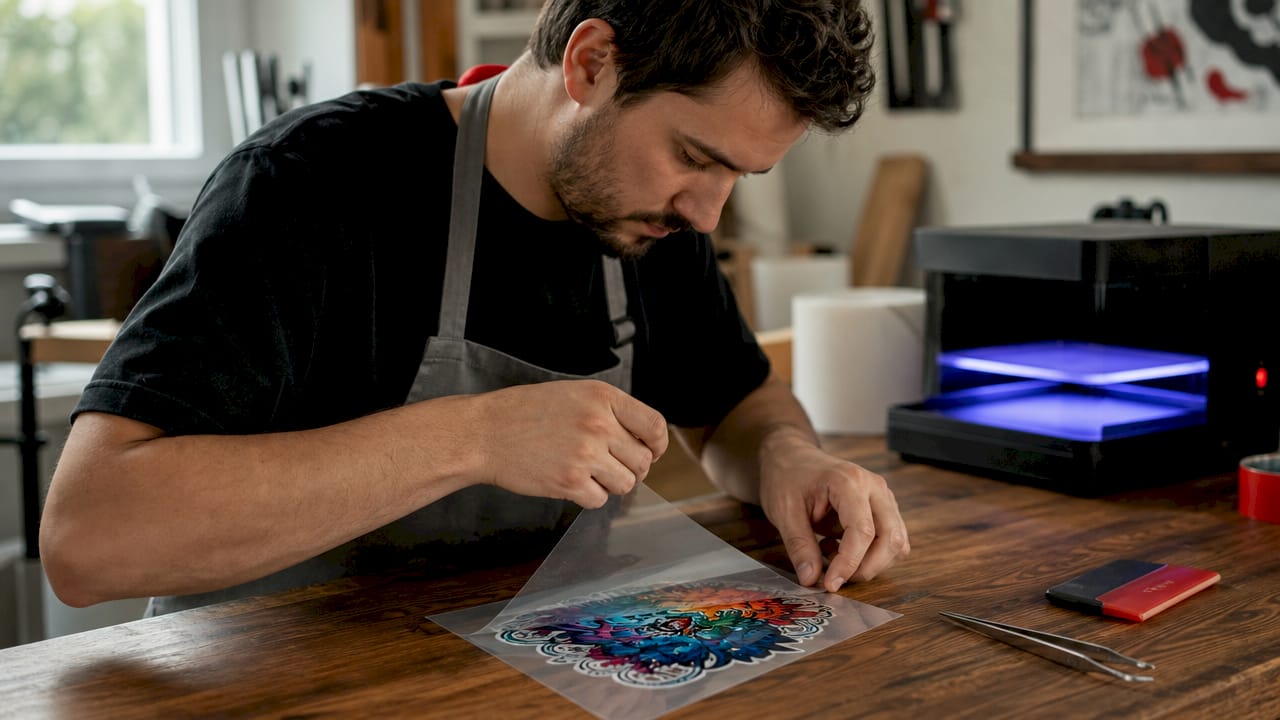
The result is a decal with a glossy, slightly raised finish that looks and feels like a varnish coating. This texture is not achievable with vinyl or standard inkjet printing. The raised profile comes directly from the UV ink layer sitting on top of the substrate rather than soaking into it.
How does the UV DTF printing process work?
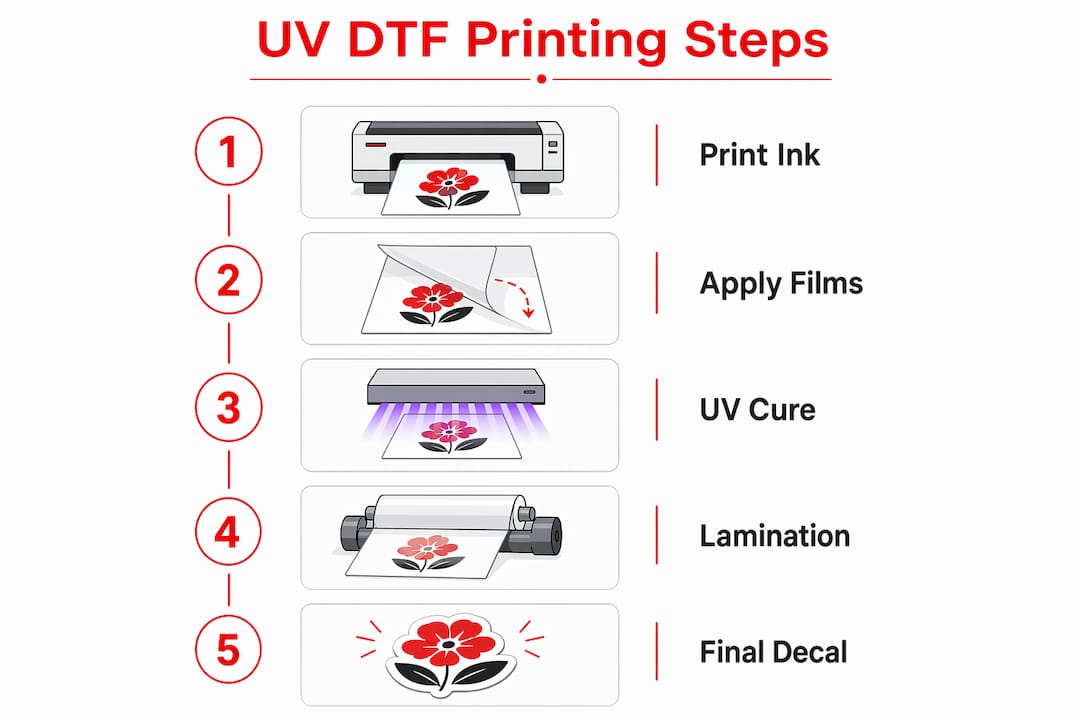
The UV DTF printing process follows four distinct steps, and each one affects the final quality of the decal.
-
Print on A film. The printer deposits UV-curable inks, including white ink, onto the A film in a single pass. UV LED lamps mounted inside the printer cure the ink instantly as it is laid down. This instant curing locks in sharp edges and prevents ink spread.
-
Laminate with B film. The printed A film passes through a laminator that bonds the B film to the ink surface. The B film provides the adhesive layer and protects the design during handling and shipping.
-
Cut and prepare. The laminated sheet is cut to the desired decal shape. No weeding is required. The entire printed area transfers as one piece.
-
Peel and apply. The user peels the A film away, exposing the adhesive side of the design, then presses the decal onto the target surface by hand or with a squeegee.
Proper UV curing is the most critical variable in this process. Under-cured ink produces a decal that loses adhesion quickly and scratches easily. UV output settings and print speed must be calibrated to complete the chemical photopolymerization process fully. Operators who rush print speed to increase output often sacrifice durability.
Pro Tip: If you are ordering UV DTF transfers from a supplier, ask whether they calibrate UV intensity per ink color. White ink typically requires a different cure setting than CMYK layers.
What surfaces and products are ideal for UV DTF decals?
UV DTF decals perform best on hard, smooth, or lightly textured surfaces. The adhesive layer bonds to rigid substrates where it can make full contact. Common compatible surfaces include:
- Glass: Tumblers, wine glasses, beer mugs, windows, and mirrors
- Metal: Stainless steel drinkware, aluminum signs, tool cases, and promotional items
- Ceramic: Mugs, tiles, and decorative plates
- Plastic: Phone cases, acrylic signs, water bottles, and packaging
- Wood: Cutting boards, frames, ornaments, and gift boxes
- Acrylic: Awards, signage, and display pieces
The glossy, scratch-resistant finish makes UV DTF decals especially popular on drinkware and handled items that see daily use. A stainless steel tumbler with a UV DTF decal holds up to hand washing and regular handling far better than a standard paper label or an uncoated inkjet print.
Flexible or fabric surfaces are not compatible with UV DTF. The cured ink layer is rigid. Applying a UV DTF decal to a fabric surface or a highly flexible plastic risks cracking the ink layer when the substrate bends. Small businesses should use traditional DTF transfers for apparel and fabric items, and reserve UV DTF for hard-surface products.
Handmadeohiocrafts applies UV DTF decals to products like custom steel tumblers, where the combination of a smooth metal surface and a durable decal finish produces a retail-quality result.
How does UV DTF compare to vinyl decals and traditional DTF?
The three most common methods for decorating hard surfaces are vinyl decals, traditional DTF transfers, and UV DTF decals. Each has a different production workflow and a different output quality.
Vinyl decals are cut from solid-color sheets. They work well for simple logos and text but cannot reproduce photographic images or gradients without complex multi-layer builds. Every color requires a separate cut and weed step. Labor adds up fast on detailed designs.
UV DTF eliminates weeding entirely and prints full-color photographic images, including white ink, in a single pass. A design with 12 colors takes the same production time as a two-color design. That is a significant production advantage for small businesses with varied custom orders.
| Feature | Vinyl decals | UV DTF decals |
|---|---|---|
| Color range | Spot colors only | Full photographic color |
| White ink | Not available | Printed in single pass |
| Weeding required | Yes | No |
| Application method | Cut, weed, transfer tape | Peel and press |
| Finish | Flat or matte | Glossy, raised texture |
| Best surface | Smooth flat panels | Glass, metal, ceramic, plastic, wood |
| Durability | Good | Waterproof, scratch-resistant |
Traditional DTF for fabric uses heat and adhesive powder. It is the right tool for t-shirts and hoodies. It does not work on glass or metal. UV DTF fills the gap for hard-surface decoration that requires full-color output and durability.
Pro Tip: For branded merchandise that includes both apparel and hard goods, use traditional DTF for the shirts and UV DTF for the tumblers or phone cases. The two processes complement each other and cover the full product range.
How to apply UV DTF decals for best results
Correct application technique determines whether a UV DTF decal lasts for years or peels within weeks. Follow these steps for consistent results.
-
Clean the surface. Wipe the target surface with isopropyl alcohol and let it dry completely. Oils, dust, and residue prevent the adhesive from bonding fully.
-
Position before committing. Hold the decal over the surface and confirm placement before peeling. Once the adhesive touches the surface, repositioning is difficult without damaging the decal.
-
Use the hinge method for larger decals. Tape one edge of the decal to the surface as a hinge. Peel the A film back slowly from the opposite edge while pressing the exposed adhesive down with a squeegee or credit card. Pressing from the hinge side outward pushes air out ahead of the decal and prevents bubbles.
-
Press firmly across the full design. Apply firm, even pressure across the entire decal surface. Pay extra attention to edges and corners, which are the first areas to lift.
-
Remove the carrier film slowly. Peel the remaining film at a low angle, close to the surface. Pulling straight up risks lifting the decal edges.
Common mistakes include applying decals to cold or damp surfaces, skipping the alcohol wipe, and peeling the carrier film too quickly. Each of these causes edge lifting or partial adhesion failure.
Pro Tip: On curved surfaces like tumblers, make small relief cuts at the edges of the decal before applying. This lets the decal conform to the curve without wrinkling.
Key takeaways
UV DTF decals are the most practical full-color, no-heat solution for decorating hard surfaces like glass, metal, ceramic, and wood, combining photographic print quality with waterproof durability.
| Point | Details |
|---|---|
| Definition | UV DTF decals are full-color, permanent transfers made with UV-curable inks on A/B film. |
| No heat required | The peel-and-stick process works on hard surfaces without a heat press or vinyl weeding. |
| Surface compatibility | Best on glass, metal, ceramic, plastic, wood, and acrylic. Not suitable for fabric. |
| Durability | UV-cured ink produces a waterproof, scratch-resistant, glossy raised finish. |
| Production advantage | Full photographic color prints in one pass, faster than vinyl for complex designs. |
Why UV DTF changed how I think about small-batch custom products
I have worked with a lot of printing methods over the years, and the one that surprised me most was UV DTF. Not because it is new, but because it solves a problem that vinyl and sublimation never fully addressed: how do you put a photographic-quality image on a glass tumbler without a $10,000 UV flatbed printer?
The answer turned out to be a roll of film and a calibrated UV LED printer. What I did not expect was how much the finish quality matters to end customers. The raised, glossy texture reads as premium. Customers who receive a UV DTF-decorated tumbler as a gift consistently comment on the feel of it, not just the look. That tactile quality is something vinyl simply cannot replicate.
The honest challenge for beginners is the equipment investment. A UV DTF printer costs more upfront than a basic vinyl cutter. For small businesses just starting out, ordering custom UV DTF transfers from a supplier like Handmadeohiocrafts makes more sense than buying equipment before you know your volume. You get professional curing and lamination without the learning curve on machine calibration.
The niche I see most underserved is branded hard goods for small events: corporate gifts, wedding favors, school fundraisers. A set of 50 custom tumblers with a photographic logo decal looks like it came from a large print shop. With UV DTF, a small operation in Waverly, Ohio can produce that same result. That levels the playing field in a way that matters.
— Aaron
Custom UV DTF and DTF transfers from Handmadeohiocrafts
Handmadeohiocrafts produces custom UV DTF decals and DTF transfers entirely in-house from Waverly, Ohio, with no minimum order requirement and nationwide shipping.
Whether you need UV DTF decals for personalized gifts, branded drinkware, event merchandise, or retail products, Handmadeohiocrafts handles design and production under one roof. Fast turnaround and direct customer service mean you are not waiting on a third-party fulfillment chain. Businesses, schools, sports teams, and individuals all use Handmadeohiocrafts for custom printing that holds up to real-world use. Browse the full range of custom DTF printing services or submit your artwork to get a quote.
FAQ
What is a UV DTF decal in simple terms?
A UV DTF decal is a full-color sticker made by printing UV-curable inks onto film, laminating it, and pressing it onto hard surfaces like glass or metal without heat. The result is a waterproof, glossy, permanent transfer.
Can UV DTF decals go on fabric or clothing?
UV DTF decals are not recommended for fabric. The cured ink layer is rigid and will crack when the fabric flexes or stretches. Use traditional DTF transfers for apparel.
How long do UV DTF decals last?
UV DTF decals are waterproof and scratch-resistant, making them durable for everyday use on items like tumblers and phone cases. Longevity depends on surface preparation and correct application, but properly applied decals hold up to regular hand washing.
Do you need special equipment to apply UV DTF decals?
No special equipment is needed. UV DTF decals apply by hand using a squeegee or credit card. Clean the surface with isopropyl alcohol, peel the film, and press the decal into place.
What is the difference between UV DTF and vinyl decals?
Vinyl decals are cut from solid-color sheets and require weeding. UV DTF decals print full photographic color in a single pass with no weeding, and produce a glossy raised finish that vinyl cannot match.
Recommended
- UV DTF Gang Sheet Builder – Custom Sticker Transfers | Ohio – Handmadeohio
- DTF File Requirements | Artwork Setup Guide for DTF Transfers | Handma – Handmadeohio
- DTF Transfers in Columbus Ohio | Custom DTF Printing | HandmadeOhio – Handmadeohio
- DTF Transfers | Custom Direct To Film Printing | HandmadeOhio – Handmadeohio