

What Is DTF Printing? A Small Business Guide
DTF printing, short for Direct-to-Film printing, is a process where designs are printed onto a specialized PET film sheet and then heat-pressed onto fabric to create vibrant, durable transfers. Unlike screen printing or direct-to-garment (DTG) methods, DTF requires no fabric pretreatment and works on cotton, polyester, nylon, and treated leather. That versatility makes it one of the most practical decoration methods available to small business owners today. Consumable costs run $0.45 to $1.10 per shirt, which keeps small and mixed-fabric orders profitable without the overhead of traditional print setups.
How does the DTF printing process work?
The DTF printing process follows a clear sequence of steps, each requiring specific equipment to produce a finished transfer ready for fabric application.
-
Design preparation. Your artwork file is prepared in CMYK color mode and sent to a DTF-compatible inkjet printer. The printer lays down color inks first, then deposits a white ink layer on top to create opacity. That white layer is what makes DTF transfers visible on dark fabrics without any pretreatment.
-
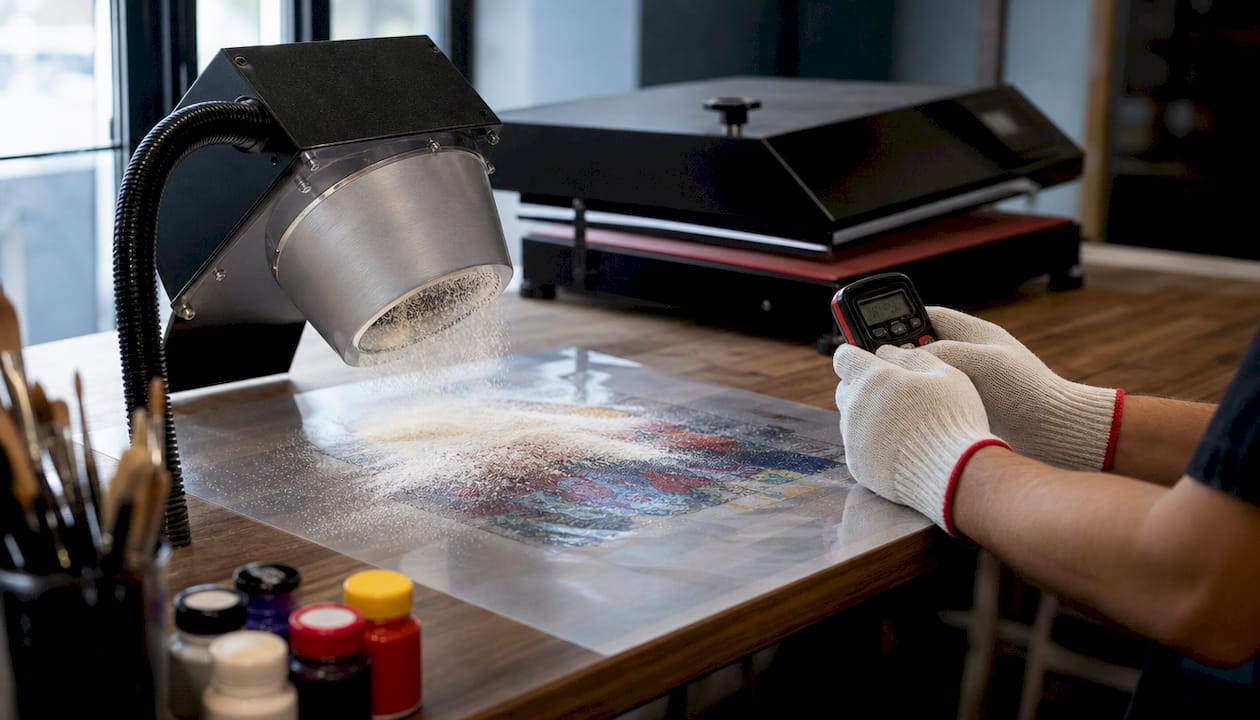
Powder application. While the ink is still wet, thermoplastic polyurethane (TPU) hot-melt adhesive powder is applied across the printed surface. A powder shaker unit distributes the powder evenly, then removes the excess. This adhesive layer is what bonds the transfer to the fabric during heat pressing.
-
Curing. The film moves through a curing station, typically a conveyor oven or heat tunnel, which melts the TPU powder into a solid adhesive coating. After curing, the transfer sheet is stable and can be stored or used immediately.
-
Heat pressing. The cured transfer is placed face-down on the fabric and pressed at 160–170 °C for 10–15 seconds. That combination of heat and pressure bonds the design permanently to the garment fibers.
-
Peeling. After pressing, the PET film is peeled away, leaving the design on the fabric. Films are rated as either hot peel or cold peel. Peeling at the wrong temperature risks cracking or transfer failure, so following the film manufacturer’s specifications is non-negotiable.
A complete DTF setup includes a DTF printer with pigment and white ink channels, a powder shaker, a curing unit, and a flat heat press. Each piece of equipment plays a specific role, and skipping or cutting corners on any one of them affects the final print quality.
Pro Tip: Always test a new film brand with a sample press before committing to a full production run. Film specs vary by manufacturer, and a 5-second peel timing difference can mean the difference between a clean transfer and a ruined garment.
What are the benefits and limitations of DTF printing for small businesses?
DTF printing delivers real advantages for small business owners, but it also comes with trade-offs worth understanding before you invest.
Where DTF printing excels
The most significant advantage is fabric versatility. DTF works on cotton, polyester, nylon, blends, and treated leather, while DTG printing favors cotton almost exclusively. That means one production method can cover your entire product catalog, from athletic wear to canvas bags to denim jackets.
Color capability is another major strength. DTF supports unlimited colors, gradients, and photographic detail at no additional cost per color. Screen printing charges more for each additional ink color, which makes complex artwork expensive at low volumes. With DTF, a 12-color photorealistic design costs the same to produce as a single-color logo.
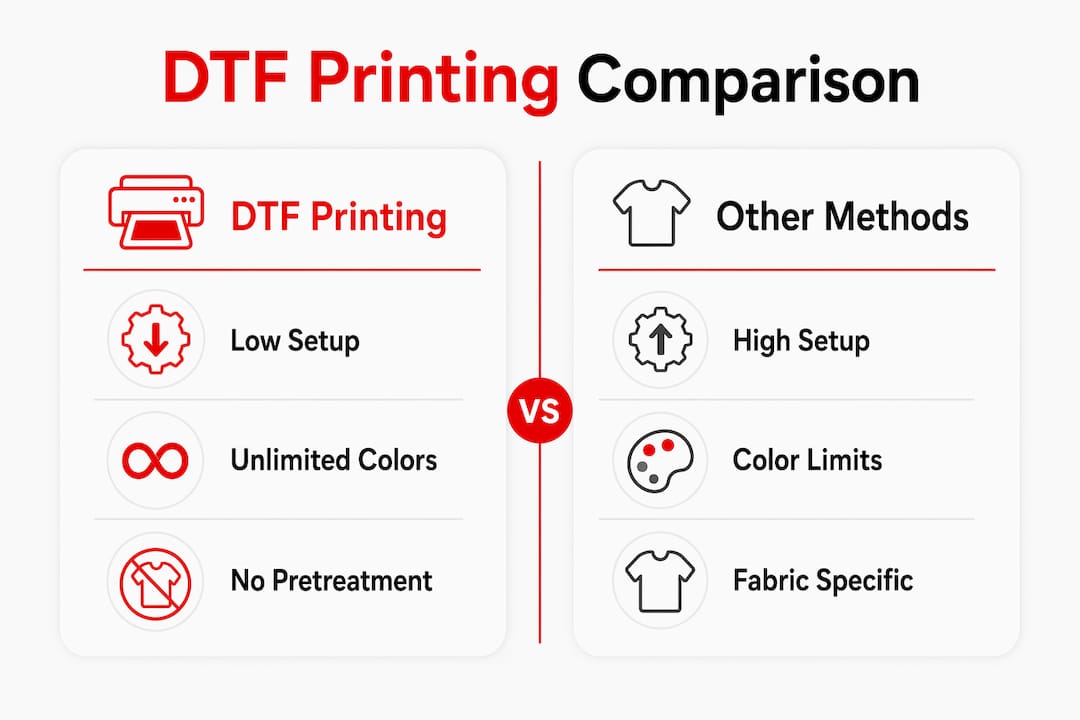
No pretreatment is required. DTG printing on dark garments demands a chemical pretreatment step that adds time, cost, and inconsistency. DTF skips pretreatment entirely, which simplifies your workflow and reduces your per-unit chemical costs.
Durability holds up well in real-world use. DTF prints maintain durability and elasticity through 50–100+ wash cycles. The initial feel of the print is slightly stiffer than a soft-hand DTG print on cotton, but that texture softens noticeably after several washes.
Where DTF printing falls short
- Print feel. DTF transfers sit on top of the fabric rather than soaking into the fibers. Customers who prefer a soft, barely-there print feel may notice the difference, especially on lightweight T-shirts.
- White ink maintenance. White ink sediments quickly and requires daily agitation and printhead upkeep. Skipping maintenance can permanently damage the printhead, which is one of the most expensive components to replace.
- Volume economics. DTF is cost-effective for orders under roughly 150–300 units. Above that threshold, screen printing’s per-unit cost drops below DTF’s consumable costs, making it the smarter choice for large runs.
- Equipment investment. A professional DTF setup requires multiple machines. The upfront cost is lower than offset printing but still significant for a first-time buyer.
Pro Tip: If you are printing fewer than 50 shirts per order, purchasing pre-made DTF transfer sheets from a supplier like Handmadeohiocrafts is often more cost-effective than running your own equipment. You skip the maintenance burden entirely.
How does DTF compare with other custom apparel printing methods?
Choosing the right printing method depends on your order size, fabric type, design complexity, and budget. Here is how DTF stacks up against the three most common alternatives.
| Factor | DTF printing | Screen printing | DTG printing |
|---|---|---|---|
| Setup cost | Low | High (per design) | Low to moderate |
| Minimum order | 1 unit | 12–24 units typical | 1 unit |
| Color limit | Unlimited | Typically 6–8 colors | Unlimited |
| Fabric compatibility | Broad (cotton, poly, nylon, leather) | Most fabrics | Primarily cotton |
| Pretreatment required | No | No | Yes (dark garments) |
| Print feel | Slightly raised, softens with washing | Soft, ink-in-fiber | Very soft on cotton |
| Best for | Small runs, mixed fabrics, complex art | Large runs, simple designs | Soft feel on cotton only |
| Durability | 50–100+ washes | Very high | Moderate to high |
Screen printing becomes more economical at volumes above approximately 150–300 units because the setup cost spreads across a larger quantity. Below that threshold, DTF wins on both flexibility and price.
DTG printing produces an exceptionally soft feel on 100% cotton but struggles with polyester blends and synthetic fabrics. DTF handles those materials without issue, making it the better choice for mixed-fabric product lines.
Sublimation is worth a brief mention. It produces vivid, permanent prints on polyester and polymer-coated hard goods, but it cannot print on cotton or dark fabrics. DTF covers both scenarios, which is why it has largely replaced sublimation for apparel decoration in small business settings.
Pro Tip: For a business selling both cotton T-shirts and polyester athletic wear, DTF is the only single method that handles both product types without a separate workflow. That operational simplicity is worth more than it looks on a cost spreadsheet.
What are the cost factors in running a DTF printing operation?
Understanding the full cost picture prevents surprises after you have already committed to equipment.
Equipment and startup costs
A professional DTF printer with white ink channels, a powder shaker, a curing unit, and a heat press represents a meaningful capital investment. Entry-level setups start in the low thousands of dollars. Commercial-grade systems capable of high-volume production cost significantly more. Neither figure includes installation, training, or the first round of consumables.
Ongoing consumable costs
DTF consumables, including ink, PET film, and TPU powder, run $0.45 to $1.10 per shirt depending on design size and ink coverage. Larger, full-coverage designs use more ink and push costs toward the higher end of that range. Small chest logos sit at the lower end.
Key operational cost factors include:
- Design size. A full-back print uses significantly more ink than a left-chest logo.
- White ink consumption. White ink is the most expensive ink in the DTF system and is used on every print regardless of design color.
- Film waste. Inefficient layout wastes film. Gang sheets solve this by combining multiple designs on a single film roll, maximizing material use and reducing heat press cycles.
- Maintenance costs. White ink requires daily printhead maintenance. Neglecting this step leads to clogs that can cost hundreds of dollars to repair or require a full printhead replacement.
Pro Tip: Build gang sheets for every production run. Combining 6–8 small designs on one film sheet instead of printing them individually can cut your film cost per design by more than half.
What products and applications work best with DTF printing?
DTF printing covers a wide range of products, which is one reason it has grown so quickly in the custom apparel and promotional products market.
Apparel is the primary use case. T-shirts, hoodies, crewnecks, and sweatshirts are the most common applications. DTF handles both light and dark garments equally well, and the broad fabric compatibility means you can decorate polyester athletic jerseys and cotton fashion tees in the same production run.
Headwear is another strong category. Structured hats and beanies accept DTF transfers well, particularly for small logos and text that would be difficult to embroider at small sizes.
Promotional and branded products benefit from DTF’s detail capability. Tote bags, nylon pouches, and fabric-covered accessories all accept transfers cleanly. For businesses producing branded merchandise for events, fundraisers, or corporate gifting, DTF delivers photographic-quality results without a screen printing minimum.
Short runs and one-off orders are where DTF truly separates itself from traditional methods. A single custom shirt for a birthday gift costs the same per-unit as a run of 20. That flexibility makes DTF the go-to method for personalized products and on-demand fulfillment.
You can review DTF file requirements before submitting artwork to make sure your designs are set up for the best possible output.
Key Takeaways
DTF printing is the most versatile low-minimum decoration method available to small businesses, combining unlimited color capability, broad fabric compatibility, and no pretreatment requirements at a consumable cost of $0.45 to $1.10 per shirt.
| Point | Details |
|---|---|
| No pretreatment needed | DTF works on cotton, polyester, nylon, and leather without any chemical prep step. |
| Unlimited color at no extra cost | Complex gradients and photographic designs cost the same to produce as single-color logos. |
| Best for under 300 units | Screen printing becomes more economical above 150–300 units per run. |
| White ink needs daily care | Skipping printhead maintenance causes clogs that can permanently damage the printer. |
| Gang sheets cut costs | Combining designs on one film sheet reduces ink, film, and press time per design. |
Why DTF changed how I think about small business printing
I have watched a lot of printing technologies come and go over the years, and most of them solve one problem while creating two others. DTF is different, and I say that with some reluctance because I am not someone who gets excited about equipment.
What changed my thinking was watching small business owners use DTF to do something that was genuinely impossible before: run a profitable custom apparel business with no minimum order requirement and no pretreatment station. The operational simplicity is real. You print, powder, cure, and press. That is the whole workflow.
The part most articles gloss over is white ink maintenance. It is not a minor inconvenience. It is a daily discipline. I have seen shops invest in solid equipment and then lose their printhead within three months because they skipped the morning agitation routine. If you are not willing to treat your printer like a piece of precision equipment that needs daily attention, DTF will cost you more than it saves.
My honest recommendation for anyone starting out: buy your transfers from a supplier before you buy your own equipment. You will learn what good output looks like, understand what your customers actually want, and figure out your real order volume before committing to a capital investment. Handmadeohiocrafts offers custom DTF transfers with no minimums, which makes that learning phase affordable.
The long-term trend I am watching is the growth of on-demand, personalized products. DTF is positioned perfectly for that market. Customers increasingly want one item with their name or design on it, not a case of 144. The method that handles single-unit orders profitably wins that market.
— Aaron
Custom DTF printing from Handmadeohiocrafts
Handmadeohiocrafts produces custom DTF transfers and finished apparel from its facility in Waverly, Ohio, with no minimum order requirements and nationwide shipping. Whether you need a single transfer for a personal project or a batch of branded shirts for your next event, every order is designed and produced in-house for consistent quality and fast turnaround.
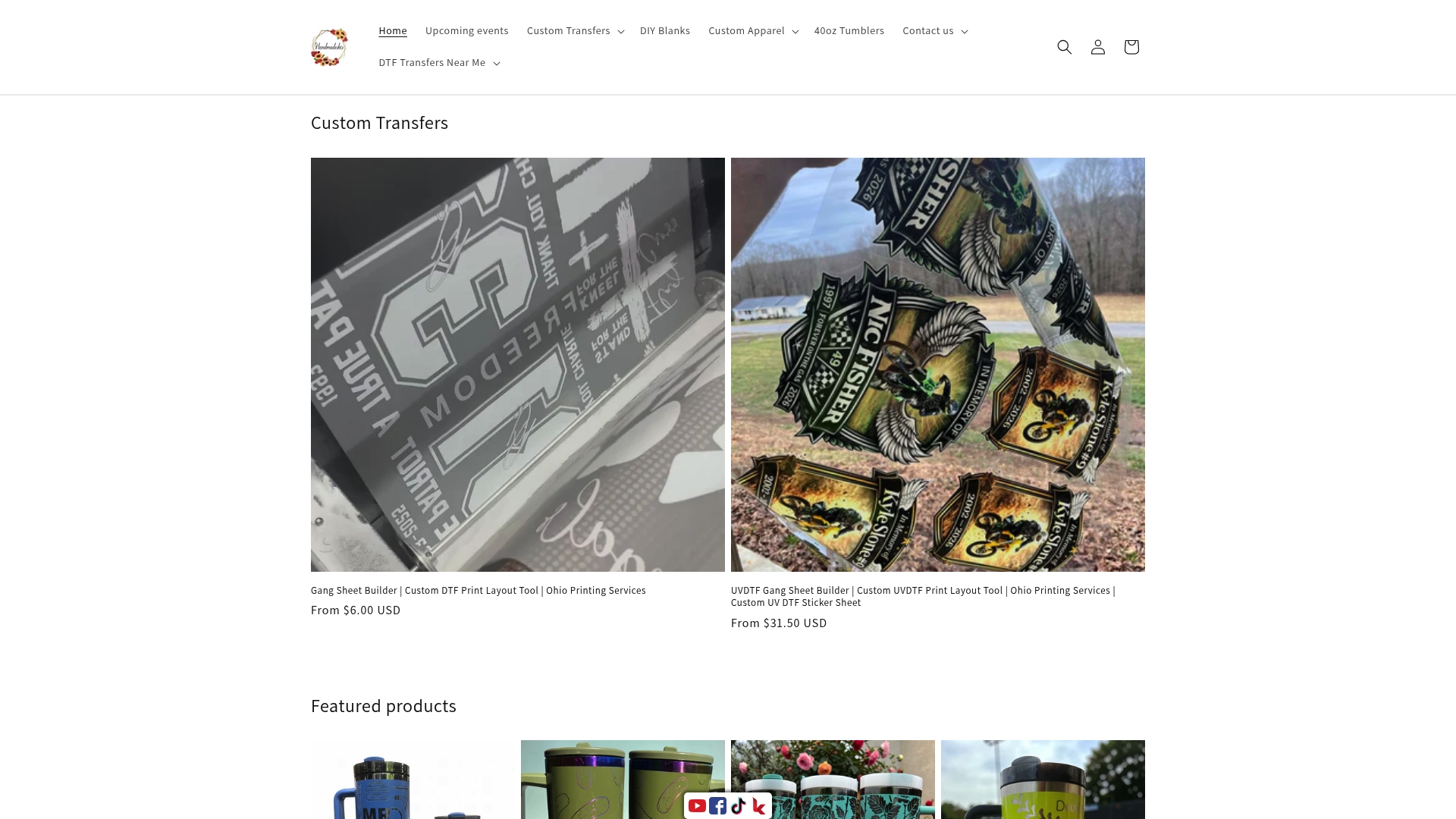
The custom apparel collection covers T-shirts, hoodies, crewnecks, hats, and more, all available with DTF decoration. If you want to supply your own blanks and apply transfers yourself, the DTF transfer service gives you ready-to-press sheets sized to your artwork. Handmadeohiocrafts works with businesses, schools, sports teams, nonprofits, and individuals across the country. Reach out directly for a quote or to discuss your project.
FAQ
What does DTF stand for in printing?
DTF stands for Direct-to-Film. The name describes the process: designs are printed directly onto a PET film sheet before being heat-transferred onto fabric.
Can DTF transfers be applied to any fabric?
DTF transfers work on cotton, polyester, nylon, fabric blends, and treated leather. This broad compatibility is one of DTF’s key advantages over DTG printing, which works best on cotton.
How long do DTF prints last after washing?
DTF prints maintain durability and elasticity through 50–100+ wash cycles. The slightly raised feel of a new transfer softens after several washes.
Is DTF printing cost-effective for small orders?
DTF consumables cost $0.45 to $1.10 per shirt, making it cost-effective for orders under roughly 150–300 units. Above that volume, screen printing typically becomes more economical.
What is a DTF transfer sheet?
A DTF transfer sheet is a piece of PET film printed with a design and coated with TPU adhesive powder, ready to be heat-pressed onto fabric. Transfer sheets can be purchased pre-made from suppliers like Handmadeohiocrafts and applied with a standard heat press.
Recommended
- DTF Transfer Setup for Brands: A Practical Guide – Handmadeohio
- UV DTF Decals Explained: What Small Businesses Need to Know – Handmadeohio
- DTF Transfers in Columbus Ohio | Custom DTF Printing | HandmadeOhio – Handmadeohio
- DTF File Requirements | Artwork Setup Guide for DTF Transfers | Handma – Handmadeohio