

Branded Crewneck Examples Every Company Should Know
The fastest way to turn crewnecks into effective company swag is to pick one clear use case, one decoration method, and one trusted vendor. For most businesses, a left-chest logo in embroidery or DTF print covers most typical situations — it reads professional at close range, survives the wash, and works whether the crewneck lands on an employee, a client, or a conference attendee. Consistent branded apparel increases brand visibility and customer recall in ways that digital ads simply cannot replicate.
Your three immediate next steps:
- Pick your use case — employee uniform, event swag, client gift, retail merch, or team apparel. The use case determines placement and decoration method.
- Pick placement and decoration — chest embroidery for corporate subtlety, center-front DTF print for bold event merch, sleeve text for secondary branding.
- Request a proof — never approve a production run without a high-res virtual proof or physical sample. Handmadeohiocrafts offers both.
Key Takeaways
Branded crewnecks work best when the garment quality, decoration method, and placement are chosen together for a specific use case, not assembled from defaults.
| Point | Details |
|---|---|
| Match decoration to use case | Embroidery for corporate uniforms; DTF for event merch and complex art; screen print for large simple-design runs. |
| Choose midweight-to-heavyweight fleece | 300–400 GSM fleece holds shape, supports embroidery, and signals quality to recipients. |
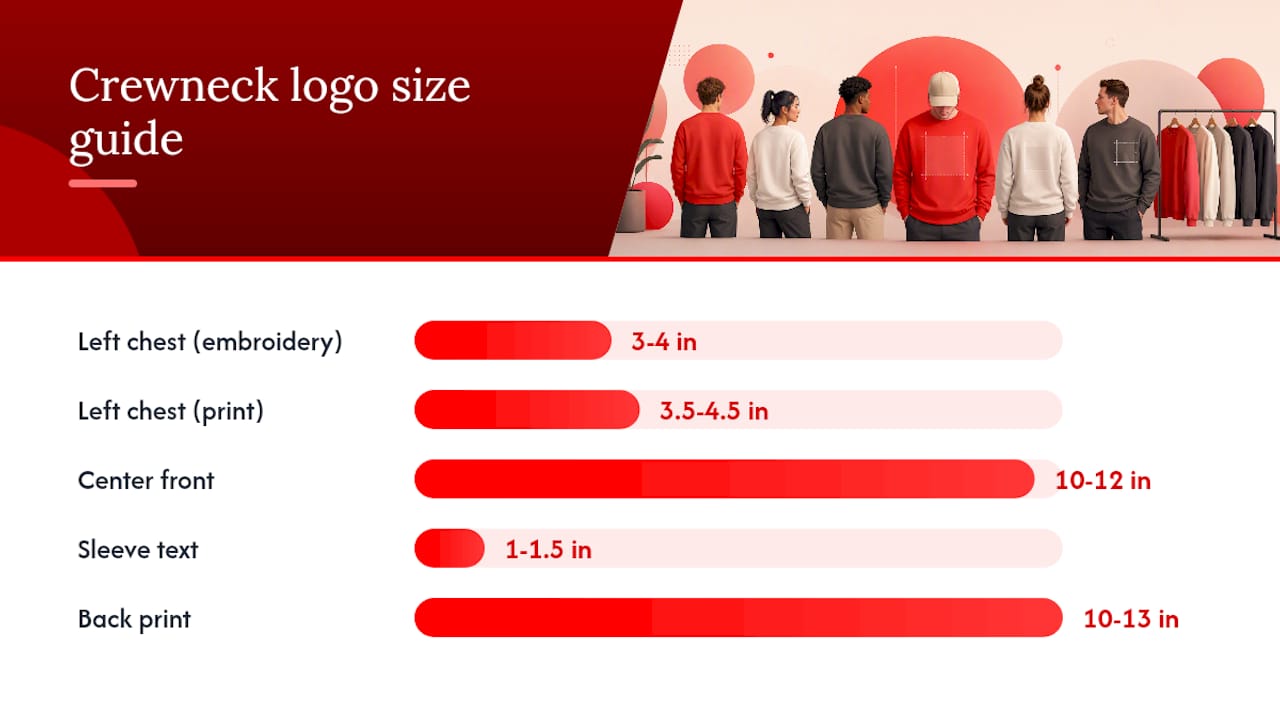
| Design for distance | Size chest logos at 3–4 inches wide; center-front art at 10–12 inches maximum for a professional result. |
| Always request a proof | Approve a high-res virtual proof or physical sample before any production run to catch color and placement issues. |
| Handmadeohiocrafts | No-minimum orders, in-house DTF production, and nationwide shipping make it a practical choice for test runs and full company orders. |
Table of Contents
- What do branded crewneck examples look like for company use?
- Which decoration method is right for your crewneck order?
- How do materials affect the quality of a branded crewneck?
- Design dos and don’ts for a professional branded crewneck
- What should you ask before placing a company crewneck order?
- How do you wear a branded crewneck in a business-casual setting?
- How does Handmadeohiocrafts produce company crewnecks?
- How do you choose the right vendor for company crewnecks?
- What actually matters when branding a crewneck for your company
- Handmadeohiocrafts makes company crewneck ordering straightforward
- Sources
What do branded crewneck examples look like for company use?
The strongest branded crewneck examples for company use share one trait: the design serves the context, not the other way around. A crewneck worn daily by a customer-facing employee needs a different treatment than one handed out at a music festival. Here is how that breaks down by use case.
Employee uniforms
- Left-chest embroidered logo on a midweight navy or charcoal crewneck. Clean, durable, and reads as intentional rather than promotional. Works for retail, hospitality, and office environments.
- Center-front screen print with wordmark in one or two colors. Slightly bolder than embroidery; suits trades, warehouses, and outdoor crews where visibility matters more than subtlety.
- Sleeve text with department or role name paired with a small chest logo. Useful when you need to differentiate teams (Sales, Events, Support) without ordering separate garments.
Event swag and promotional giveaways
- Full center-front DTF art with event name, date, and sponsor logos. DTF handles multicolor gradients and fine detail that screen print cannot, making it the go-to for one-off event runs.
- Back-print statement design with a small front logo. Gives attendees something worth keeping, which extends the brand’s reach well past the event itself.
- Limited-color co-branded design for partnership events. Co-branding research from HubSpot consistently shows that simple, wearable designs with two or fewer colors reach broader audiences than complex artwork.
Client gifts and retail merch
For client gifts, subtlety wins. A small embroidered patch on the chest or a tonal print (same-color ink on a similar-tone fabric) signals quality without screaming “promotional item.” Retail merch flips that logic: bold graphic crewnecks with original artwork sell because they look like something the customer would have bought anyway.
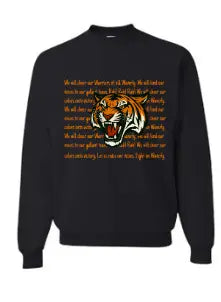
The Tigers Fight Song Crew Neck from Handmadeohiocrafts is a strong real-world example. It uses a center-front print with team-specific typography, demonstrating how a single placement decision can carry the entire brand identity of a team or organization. The same approach adapts directly to company merch: swap the fight song art for your wordmark or brand illustration, and the format holds.
For seasonal or event-specific runs, a holiday crewneck approach — limited art, limited run — creates urgency and collectibility that standard uniform pieces never achieve.
Which decoration method is right for your crewneck order?
The short answer: embroidery for corporate longevity, DTF for full-color art, screen print for large runs of simple designs, heat transfer vinyl for small batches, and sewn patches for a premium tactile finish.
| Method | Best For | Durability | Color Range | Setup Cost |
|---|---|---|---|---|
| Embroidery | Logos, wordmarks, small chest art | Excellent | Limited (thread colors) | Moderate |
| Screen print | Simple designs, large runs | Very good | Good (spot colors) | Moderate per color |
| DTF transfer | Full-color art, gradients, photos | Very good | Unlimited | Low (no screens) |
| Heat transfer vinyl | Small batches, names/numbers | Good | Limited | Very low |
| Sewn patches | Premium gifts, branded patches | Excellent | Moderate | Higher |
Embroidery adds dimension and texture that reads as premium at close range. The trade-off is that fine detail and gradients do not translate well into thread. Keep embroidered logos simple: bold lines, no thin serifs, no gradients.
Screen print is still the workhorse for runs of 24 or more identical pieces. Cost per unit drops significantly with volume, but each color requires a separate screen, so designs with four or more colors get expensive fast.
DTF (direct-to-film) transfers are where Handmadeohiocrafts excels in-house. DTF prints a full-color design onto a film sheet, which is then heat-pressed onto the garment. No screens, no minimums, and the color fidelity is hard to beat for complex artwork. It is the right call for event merch, retail pieces, and any design with gradients or photographic elements.
Heat transfer vinyl suits personalization (names, numbers, one-offs) but is not the right choice for a production run of 50 crewnecks — the labor cost per unit adds up quickly.
Sewn patches deliver a heritage, premium feel. They work especially well on the chest or sleeve of a heavyweight crewneck for executive gifts or limited-edition brand collections.
Pro Tip: Combine methods for a premium result without a premium price. An embroidered chest logo paired with a DTF back print gives you the tactile quality of embroidery where people look first, and the full-color flexibility of DTF where the design can breathe.
How do materials affect the quality of a branded crewneck?
Choose midweight-to-heavyweight fleece (300–400 GSM) for most company applications. It holds its shape after repeated washing, gives embroidery and print a stable surface, and signals quality to whoever receives it.
Fabric comparison at a glance:
- 100% cotton fleece — soft, breathable, and print-friendly, but prone to shrinkage if not pre-shrunk. Best for casual merch and retail pieces.
- Poly-cotton blend (typically 50/50 or 60/40) — more dimensional stability, less shrinkage, and slightly better moisture management. The standard choice for employee uniforms that see daily wear.
- 100% polyester/synthetic fleece — lightest weight, best for athletic and outdoor contexts, but DTG and some DTF inks can appear less vibrant on synthetic fibers.
For premium positioning, look for ring-spun or combed cotton. Both processes remove short fibers before spinning, producing a smoother, stronger yarn that holds color better over time. A vendor listing 520 GSM heavyweight cotton fleece is signaling a garment built for long-term wear, not a seasonal giveaway.
Construction details that separate a $12 blank from a $35 one:
- Double-stitched seams at the shoulders and sides
- Taped neck seam (prevents stretching and curling at the collar)
- Ribbed cuffs and hem (maintains shape after washing)
- Pre-shrunk fabric (critical for embroidery registration accuracy)
If the crewneck is going to a client or a senior employee, the construction details matter as much as the decoration. A logo that looks perfect on a fresh garment but sits crooked after three washes reflects on the brand.
Design dos and don’ts for a professional branded crewneck
Design for distance. The logo or artwork should read clearly from the distance at which it will actually be seen: arm’s length for a client gift, 10 feet for a trade show booth, 30 feet for a team on a field.
Placement and sizing checklist:
- Left-chest logo: 3–4 inches wide for embroidery; 3.5–4.5 inches for print
- Center-front art: 10–12 inches wide maximum (wider reads as streetwear, not corporate)
- Sleeve text: 1–1.5 inches tall, running parallel to the seam
- Back print: 10–13 inches wide, centered between shoulder blades and waist
Color contrast rules:
- Dark garment, light ink — always. Light garment, dark ink — always. Never print light ink on a light garment without an underbase layer.
- Limit brand colors to two or three on the garment. More than three creates visual noise that competes with the logo itself.
- For embroidery, match thread colors to your Pantone or brand hex values as closely as possible and request a thread-color swatch before approving production.
Artwork preparation:
- Submit vector files (.AI, .EPS, .SVG) for embroidery and screen print. Raster files (.PNG, .JPG) work for DTF but must be at least 300 DPI at print size.
- Use transparent backgrounds on all files. A white background on a dark garment will print as a white rectangle.
- Convert all fonts to outlines before submitting — vendors do not always have your brand typeface installed.
HBR research on emotional connection makes the business case plainly: customers and employees who feel an emotional bond with a brand are more loyal than those who are merely satisfied. A crewneck that looks and feels premium is one of the most direct physical expressions of that bond.
Pro Tip: Always request a high-res virtual proof and check it on both a phone screen and a monitor before approving. Colors render differently across devices, and catching a color shift at proof stage costs nothing. Catching it after production costs everything.
What should you ask before placing a company crewneck order?
Before you send a purchase order, get clear answers to these six questions from any vendor:
- What is the minimum order quantity? Some vendors require 24 or 48 pieces per design. Handmadeohiocrafts has no minimum, which matters for test runs and small-team orders.
- What are the setup fees? Screen print vendors typically charge per screen per color. DTF and embroidery vendors may charge a digitizing fee for new artwork.
- What is the decoration cost per location? A chest logo and a back print are two separate decoration charges.
- How do you handle color matching? Ask whether they use Pantone references and whether they provide a physical swatch or press proof.
- What is your sample policy? Can you order one unit before committing to a full run?
- What is the return and exchange policy for production errors?
Pricing components to budget for:
- Base garment cost (varies by brand, weight, and color)
- Decoration setup fee (one-time per design, per method)
- Per-unit decoration cost (multiplied by number of locations)
- Rush production fee (if turnaround is under 5 business days)
- Shipping (flat rate or calculated by weight and destination)
Typical timeline from design approval to delivery:
- Sample or virtual proof: 1–3 business days
- Proof approval to production start: same day or next day
- Production run: 3–7 business days for standard orders
- Shipping: 2–5 business days (ground, nationwide)
The custom apparel ordering checklist from Handmadeohiocrafts walks through the full asset list vendors will need: brand guide, vector logo, size breakdown by style and color, and shipping destination list.
How do you wear a branded crewneck in a business-casual setting?
A clean, small-chest logo crewneck pairs with a collared shirt or blazer for a business-casual look that reads as intentional rather than promotional.
Three outfit examples by formality level:
- Casual office — branded crewneck over a plain white or light-gray tee, dark chinos, clean sneakers. The logo does the branding work; the rest stays neutral.
- Hybrid meeting or video call — crewneck layered under a structured blazer in a complementary neutral. The crewneck collar sits cleanly inside the blazer lapel and reads as polished on camera.
- Client-facing event — crewneck in the brand’s primary color, paired with tailored trousers and leather shoes. Keep the logo small and the fit trim; avoid oversized or boxy cuts that read as streetwear.
Styling tips for corporate contexts:
- Stick to the brand’s core palette. A crewneck in a color that does not appear in the brand guide creates visual inconsistency across a team.
- Choose neutral base tones (navy, charcoal, heather gray, black) when the logo is the focal point. Bright garment colors compete with the logo rather than supporting it.
- Fit matters. A crewneck that is two sizes too large undermines the professional signal regardless of how good the logo looks.
How does Handmadeohiocrafts produce company crewnecks?
Handmadeohiocrafts handles every step of production in-house at its Waverly, Ohio facility: design review, DTF printing, heat pressing, quality check, and fulfillment. No outsourced printing, no middlemen, and no minimum order requirement.
The production process in brief:
- Upload your design or work with the team to finalize artwork
- Receive a high-res virtual proof for approval (physical sample available on request)
- Production begins after approval, typically within one business day
- Finished crewnecks are quality-checked and shipped nationwide
The Tigers Fight Song Crew Neck is a concrete example of what in-house DTF production delivers: sharp center-front typography, clean edges, and vibrant color on a comfortable fleece blank. The same production process applies to company orders, whether that is 1 piece for a founder or 100 pieces for a sales team.
Handmadeohiocrafts’s in-house capabilities include DTF transfers, UV DTF decals, laser engraving, and sublimation, which means a single vendor can handle crewnecks, tumblers, hats, and promotional products in one order.
How do you choose the right vendor for company crewnecks?
Prioritize sample policy, transparent pricing, and brand safety. A vendor who cannot show you a physical sample or a high-res proof before production is a vendor who is comfortable with surprises you will pay for.
Vendor evaluation checklist:
- Can they produce a single sample before a full run?
- Is pricing itemized (garment, setup, decoration, shipping) or quoted as a lump sum?
- Do they use Pantone or brand-matched color references?
- What is their stated turnaround time, and do they have a history of meeting it?
- Is production in-house or outsourced to a third party?
- What is the quality-control process before shipping?
Red flags to watch for:
- Vague turnaround estimates (“2–4 weeks, depending on volume”) with no commitment
- Setup fees that appear only after you have approved the quote
- No high-res proof option — only a low-resolution mockup
- No clear policy for production errors or misprints
- Outsourced production with no visibility into the supply chain
The custom apparel ordering checklist is worth reviewing before your first vendor call. Going in with your size breakdown, vector files, and color references already prepared shortens the quote process and signals to the vendor that you are a serious buyer.
What actually matters when branding a crewneck for your company
Most branding teams overthink the decoration method and underthink the garment itself. A well-constructed, midweight fleece in a brand-appropriate color communicates quality before anyone reads the logo. A thin, boxy blank in a generic color communicates the opposite, regardless of how good the print looks.
The second thing teams consistently underestimate is the value of a no-minimum order policy. Testing a new crewneck design with 5 or 10 pieces before committing to 100 is not indecisive — it is how you avoid a warehouse full of crewnecks nobody wants to wear. Comparing hoodies and crewnecks for employee apparel is worth doing before you lock in a style, too. Crewnecks tend to layer better and read more polished in office contexts; hoodies win for outdoor events and casual team culture.
The practical trade-off I see most often: companies choose embroidery because it sounds premium, then discover their logo has thin lines or gradients that do not digitize cleanly. DTF is often the better call for complex logos, and it costs less per unit on small runs. Save embroidery for simple, bold marks where the thread texture genuinely adds value.
Handmadeohiocrafts makes company crewneck ordering straightforward
Skip the vendor search. Handmadeohiocrafts produces custom crewnecks in-house in Waverly, Ohio, with no minimum order, transparent pricing, and nationwide shipping. Whether you need 3 samples to test a new employee uniform or 150 pieces for a product launch event, the process is the same: upload your design, approve a proof, and receive finished crewnecks ready to wear or ship.
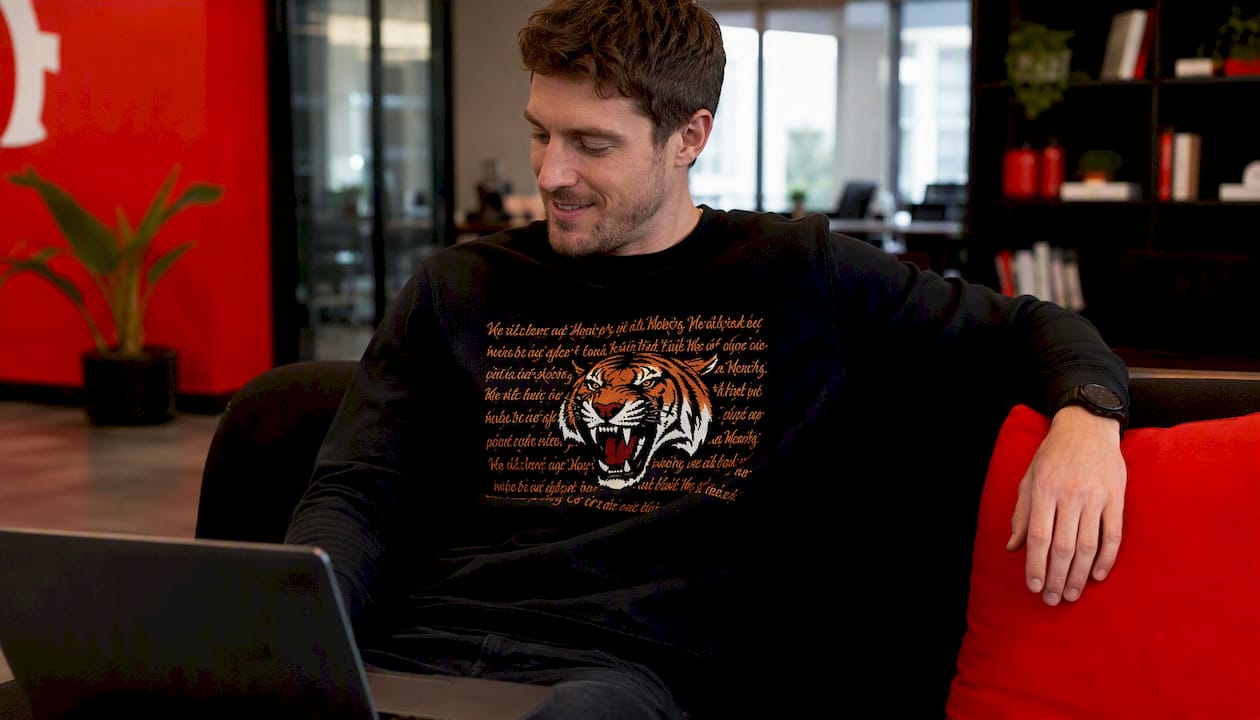
DTF printing, embroidery, and heat-press decoration are all handled under one roof, which means no outsourced production delays and no color-matching surprises between vendors. The Tigers Fight Song Crew Neck shows the finished quality you can expect from a center-front DTF print on a comfortable fleece blank. Request a custom quote or upload your design directly at Handmadeohiocrafts to get a proof within one to three business days.
Sources
- An emotional connection matters more than customer satisfaction — Harvard Business Review
- The best co-branding partnerships (examples) — HubSpot Blog