

Quality Control Printing: A Complete Guide for Print Pros
Quality control printing is the continuous process of verifying that printed materials meet precise specifications and quality standards at every stage of production. The industry term is print quality control (PQC), and it covers three structured phases: pre-press, during-press, and post-press. Tools like densitometers, spectrophotometers, and standards such as ISO 12647 and G7® define the measurement benchmarks. Without a formal PQC system, color drift, misregistration, and finishing defects reach clients, eroding brand trust and triggering costly reprints.
What is quality control in printing, and why does it matter?
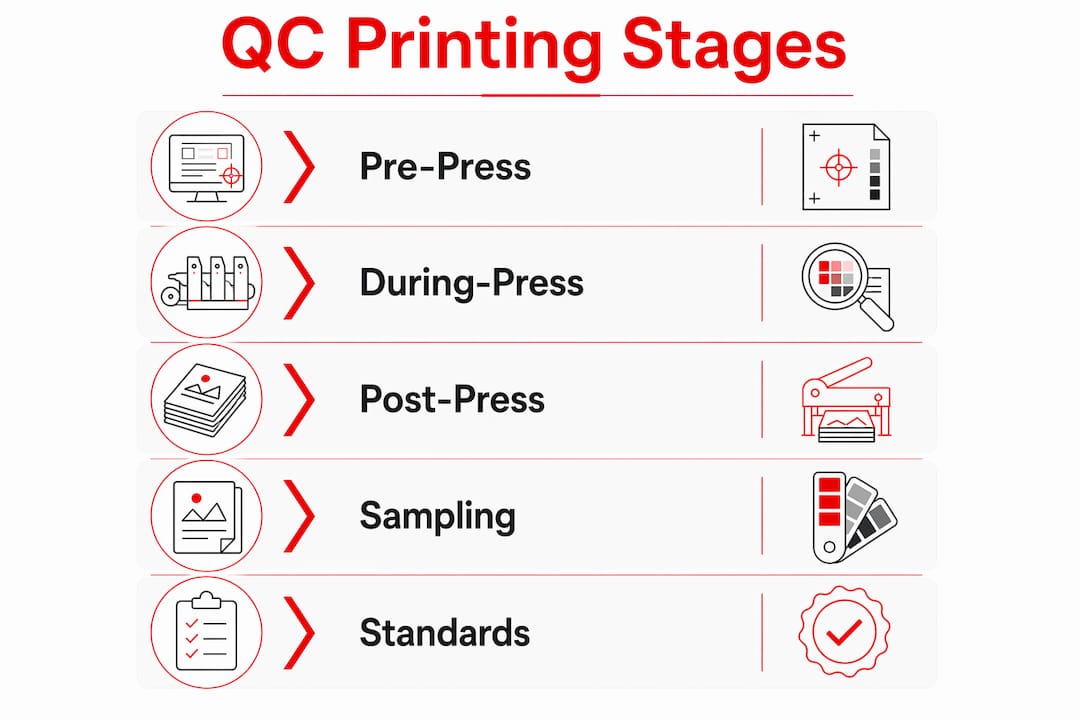
Quality control printing is defined as a structured, multi-phase inspection process covering file preparation, press monitoring, and final product review. Each phase catches a different class of defect. Pre-press catches file errors before ink touches substrate. During-press monitoring catches color drift and registration shifts in real time. Post-press inspection catches trimming, binding, and finishing failures before products ship.
The importance of quality control in printing goes beyond aesthetics. A single uncorrected color shift on a brand’s packaging can mean thousands of rejected units. Consistent PQC protects the client relationship, reduces waste, and keeps production costs predictable. Print businesses that skip formal quality checks trade short-term speed for long-term rework costs.

Pre-press is the most cost-effective stage to catch defects. A file error found before plates are made costs minutes to fix. The same error found after a full press run costs materials, press time, and client goodwill.
What are the main stages of quality control in printing?
Quality control processes in printing follow three sequential phases. Each phase has defined checkpoints, tools, and pass/fail criteria.
1. Pre-press quality checks
Pre-press QC covers everything that happens before the press runs. File audits check bleed, trim, fonts, and color profiles to catch errors that would cause visible defects on press. A 1 mm misalignment in a file can become a multi-millimeter placement error on the finished product. Color profile verification confirms that the file uses the correct ICC profile for the target substrate and press condition. Operators also confirm resolution, overprint settings, and ink coverage limits at this stage.
Pro Tip: Run a preflight check using tools like Adobe Acrobat Pro or Enfocus PitStop before sending any file to press. Automated preflight catches the majority of common file errors in seconds.
2. During-press monitoring
During-press quality control is where real-time measurement becomes critical. Densitometers and spectrophotometers measure ink density and color accuracy throughout the run. Operators pull sheets at defined intervals, measure solid ink density, check dot gain, and verify registration against the approved proof. Visual inspection confirms image clarity and surface finish. Any reading outside tolerance triggers an immediate press adjustment, not a wait-and-see approach.
Registration checks are non-negotiable on multicolor work. A shift of even half a point on a tight trap causes visible color fringing. Operators use registration marks printed outside the trim area to verify alignment on every sampled sheet.
3. Post-press inspection
Post-press QC covers trimming accuracy, binding integrity, lamination adhesion, and packaging. Sampling plans define how many finished pieces get inspected per lot. Inspectors check cut dimensions against spec, verify fold accuracy, and test binding strength on bound products. Any defect found at this stage triggers a hold on the lot pending a full review.
Post-press failures are the most expensive to correct because they occur after all production costs have been incurred. A lamination bubble or a trim that is 2 mm off spec on 10,000 brochures means the entire job may need to be redone. Catching these issues through systematic sampling, rather than waiting for a client complaint, is the difference between a manageable rework and a full reprint.
How do modern tools and standards improve print accuracy?
The tools and standards used in print quality assurance give operators objective, repeatable measurements instead of subjective visual judgments.
| Tool or Standard | What it measures | Primary benefit |
|---|---|---|
| Densitometer | Solid ink density | Tracks ink film thickness consistently |
| Spectrophotometer | Color values (Lab, ΔE) | Measures perceptual color match to proof |
| ISO 12647 | Process control tolerances | Defines pass/fail targets for offset lithography |
| G7® methodology | Neutral gray balance | Ensures color consistency across presses |
Densitometers measure how much light a printed ink film absorbs. They are fast and inexpensive, making them practical for frequent in-run checks. Spectrophotometers go further by measuring color in Lab values and calculating delta E (ΔE), the numerical difference between the printed color and the target. Proof-to-press correlation uses ΔE values as objective pass/reject criteria, removing guesswork from approval decisions.
ISO 12647-2:2013 specifies target values for offset lithography, including tone value increase, solid ink density, and color tolerances. These targets give print buyers and print providers a shared, contractual reference point.
G7® methodology measures neutral gray balance rather than purely mechanical attributes. This distinction matters because two presses can show identical ink density readings but produce visibly different color results. G7 corrects for that gap by calibrating each press to a common gray reference, improving cross-press consistency even when substrates or ink sets differ.
Pro Tip: Calibrate spectrophotometers and densitometers on a documented schedule, at minimum once per shift on high-volume runs. An uncalibrated instrument gives false confidence, which is worse than no measurement at all.
What sampling methods and SOPs govern high-volume print QC?
High-volume print runs cannot inspect every piece. AQL sampling based on ISO 2859-1 provides a statistically valid method for testing lots by inspecting a defined sample size and accepting or rejecting the lot based on the defect count found.
AQL works by assigning defect categories (critical, major, minor) and setting maximum acceptable defect rates for each. A critical defect, such as wrong color on a brand logo, carries a tighter AQL than a minor defect, such as a slight ink hickey in a non-critical area. This tiered approach focuses inspection effort where the risk is highest.
Documented SOPs define every measurement point, target tolerance, sampling frequency, and corrective action for each defect type. A well-written SOP for a press run covers:
- Solid ink density targets and acceptable tolerance bands
- Dot gain targets at 50% tonal value
- Gray balance verification against a G7 reference
- Registration tolerance in millimeters
- Post-press checks: trim dimensions, fold accuracy, binding pull strength
- Corrective action steps when any measurement falls outside tolerance
- Sign-off requirements before a job advances to the next stage
SOPs do more than document procedure. They create accountability. When a press operator follows a written SOP and records measurements, the data trail shows exactly where a defect originated. That traceability reduces finger-pointing between pre-press, press, and finishing departments and speeds up root cause analysis.
For businesses ordering small batch printing, AQL sampling still applies. Even a run of 50 pieces benefits from a defined inspection plan, because the cost of a defective small batch relative to its total value is often higher than on a large run.
Why does integrating QA with QC matter for print production?
Quality assurance (QA) and quality control (QC) are related but distinct functions. QA focuses on process design and defect prevention, while QC functions as the detection and correction layer during and after production. Both are required for a complete quality management system.
QA activities in printing include:
- Designing press setup procedures that minimize color variation
- Selecting substrates and inks that perform consistently within spec
- Training press operators on measurement tools and SOP compliance
- Auditing supplier quality for incoming materials
QC activities cover the actual inspection and measurement work: pulling press sheets, measuring ΔE, checking registration, and inspecting finished goods. QC without QA means operators are constantly firefighting defects that a better process would have prevented. QA without QC means process improvements are never verified against actual output.
Together, QA and QC reduce rework, lower waste, and build the kind of consistency that clients notice. A print buyer who receives 10 consecutive jobs with color that matches the approved proof develops trust in the supplier. That trust is worth more than any single job discount.
Proper artwork file preparation is one of the clearest examples of QA in action. When clients submit files that meet documented specifications, pre-press QC becomes faster and defect rates drop measurably.
Key Takeaways
Effective print quality control requires structured inspection at pre-press, during-press, and post-press stages, supported by calibrated tools, documented SOPs, and integrated QA processes.
| Point | Details |
|---|---|
| Three-phase structure | Pre-press, during-press, and post-press checks each catch different defect types. |
| Objective measurement tools | Spectrophotometers and densitometers replace guesswork with ΔE and density data. |
| ISO 12647 and G7® standards | These standards define shared tolerances and gray balance targets for consistent color. |
| AQL sampling efficiency | ISO 2859-1 sampling lets high-volume operations make statistically valid accept/reject decisions. |
| QA prevents, QC detects | Combining both functions reduces rework costs and builds long-term client trust. |
What I’ve learned about where print QC actually breaks down
The failure point in most print QC programs is not the measurement tools. It is discipline at press changeovers. When a press switches from one job to the next under time pressure, operators skip the makeready verification sheet, skip the first-pull color check, and run 500 sheets before anyone measures anything. By then, the color is already off and the waste is already done.
Operators who use alarms and defined thresholds catch drift early, before it becomes a defect. That requires locking color governance into the SOP so that no operator can skip the check, regardless of schedule pressure. The SOP is not a suggestion. It is the control.
The second failure point is treating proof-to-press correlation as a formality rather than a contract. When a client approves a proof, that approval sets the ΔE target for the press run. Every sheet pulled during the run should be measured against that target. If the ΔE drifts beyond tolerance, the press stops. That discipline is uncomfortable when you are behind schedule, but it is far less uncomfortable than a client rejection.
My honest advice: build your QC system around measurement, not memory. Press operators who rely on visual judgment alone will drift over a shift. Operators who measure every 500 sheets and record the data will catch drift before it becomes a defect. The data also protects you in client disputes. A documented measurement record is the clearest evidence that your process was in control.
— Aaron
Handmadeohiocrafts custom printing with quality you can verify
At Handmadeohiocrafts, every custom apparel order and DTF transfer goes through documented production checks before it ships. Color accuracy, registration, and finish quality are verified at each stage, not assumed.
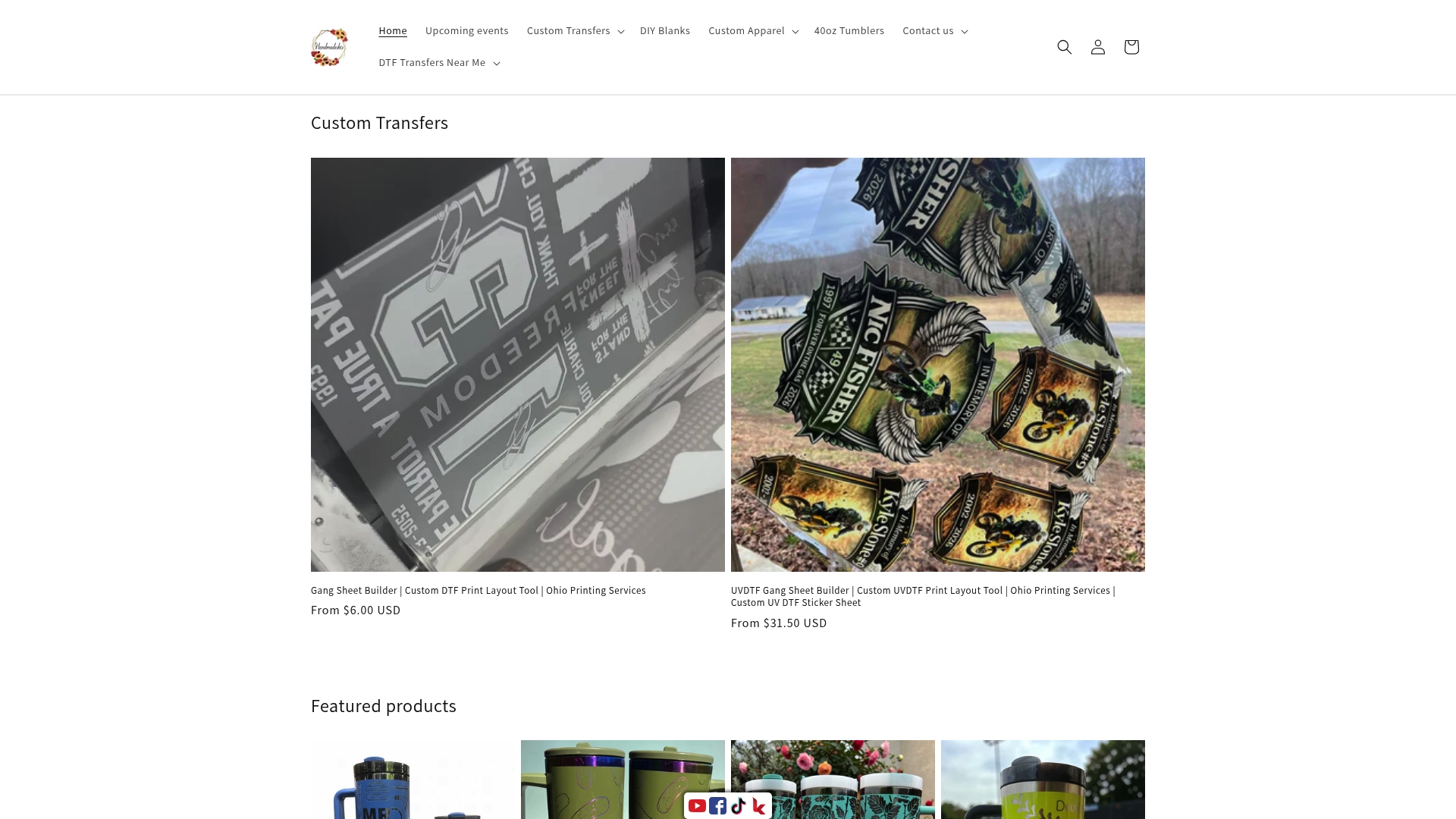
Whether you need custom apparel for a business, school, or event, or DTF transfers for your own pressing operation, Handmadeohiocrafts produces everything in-house in Waverly, Ohio. That means direct control over every production step, no outsourced guesswork, and fast turnaround without sacrificing output consistency. No minimum order requirements, nationwide shipping, and a team that treats your brand color as seriously as you do.
FAQ
What is quality control printing in simple terms?
Quality control printing is the process of checking printed materials at pre-press, during-press, and post-press stages to confirm they meet color, registration, and finishing specifications before delivery.
What tools are used in print quality control?
Densitometers measure ink density, while spectrophotometers measure color accuracy using ΔE values. Both tools give operators objective data to compare against ISO 12647 or G7® reference targets.
What is the difference between QA and QC in printing?
QA (quality assurance) focuses on designing processes that prevent defects, while QC (quality control) detects and corrects defects during and after production. Both functions work together for consistent output.
How does AQL sampling work in high-volume print runs?
AQL sampling uses ISO 2859-1 to define how many pieces to inspect per lot and how many defects are acceptable before rejecting the lot. It makes quality decisions statistically valid without inspecting every piece.
Why is pre-press the most important QC stage?
Pre-press is the most cost-effective stage because file errors caught before press setup cost minutes to fix. The same errors found after a full press run cost materials, press time, and potential client reprints.