

What Is In-House Printing? A Small Business Guide
In-house printing is defined as the practice of designing, producing, and finishing printed materials within your own organization using owned or leased equipment. Small businesses that adopt this model gain direct control over turnaround times, brand consistency, and per-unit costs. Technologies like DTF (Direct to Film) transfers, laser engraving, and digital inkjet printing have made professional-quality in-house production accessible without enterprise-level budgets. Understanding what is in-house printing, and when it makes sense for your operation, is one of the most practical decisions you can make for your brand in 2026.
What are the key benefits of in-house printing for small businesses?
In-house printing delivers four core advantages: speed, cost control, brand consistency, and data security. Each one compounds the others, making the model especially powerful for small businesses that need to move fast without sacrificing quality.
Speed and operational agility are the most immediate wins. Turnaround times drop from days or weeks to hours when you control the equipment. That matters enormously when you need last-minute event shirts, updated signage, or a corrected batch of promotional materials before a deadline.
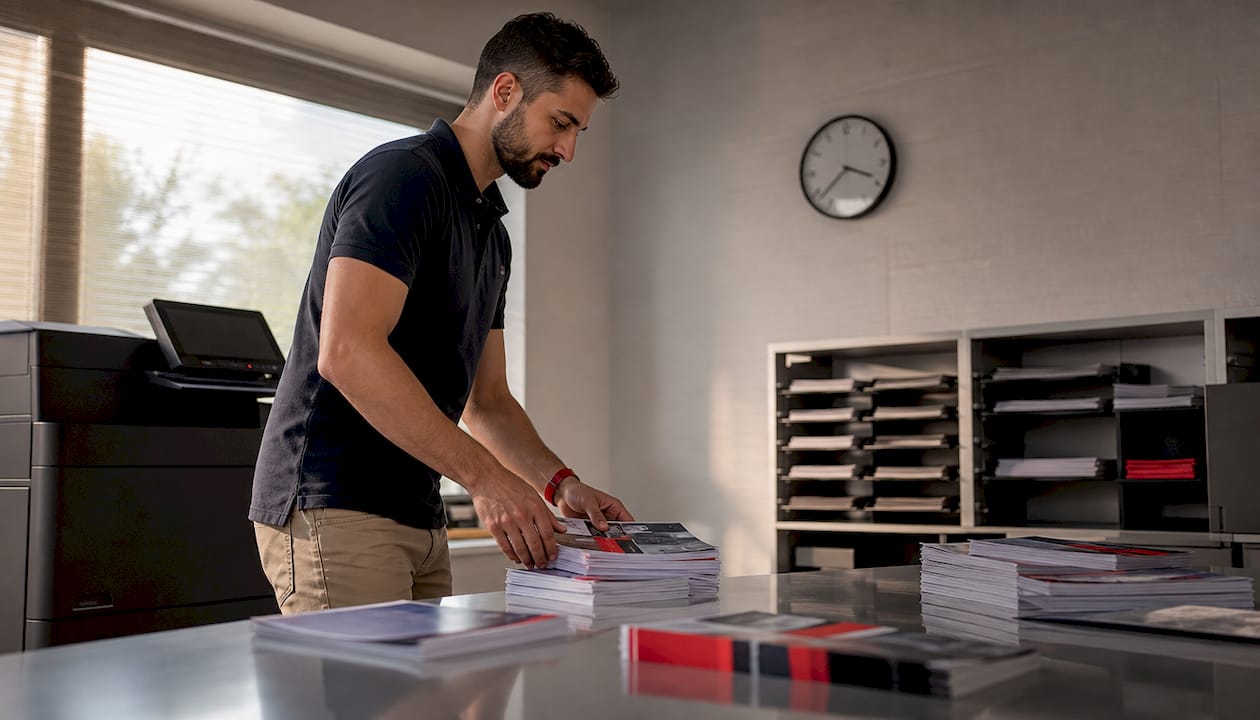
Cost predictability is the second major advantage. High-volume users benefit from structured cost-per-page models that replace fluctuating retail pricing with a fixed, forecastable spend. You stop paying a premium for someone else’s overhead and markup.
Brand control is often underestimated. When you produce materials internally, you approve every color, every layout, and every finish before it ships. Print-on-demand reduces obsolete inventory costs significantly because you print exactly what you need, when you need it, rather than ordering in bulk and discarding outdated versions.
Data privacy rounds out the list. Sensitive materials, such as employee records, financial reports, or client contracts, never leave your building. Secure print release features add another layer of protection that outsourced vendors simply cannot match.
- Near-immediate production for urgent or short-run jobs
- Predictable monthly costs through cost-per-page agreements
- Full brand approval at every stage of production
- Reduced inventory waste through print-on-demand workflows
- Stronger data security for confidential documents
Pro Tip: If you print the same materials repeatedly with minor updates, in-house production pays for itself faster than most owners expect. Calculate your current monthly outsourcing spend and compare it against a 12-month equipment lease before assuming outsourcing is cheaper.
How does the in-house printing process work?
The in-house printing process follows a clear sequence from concept to finished product. Understanding each step helps you staff correctly, choose the right equipment, and avoid the bottlenecks that slow most small operations down.
-
Design and file preparation. Every print job starts with a properly formatted digital file. Vector formats like AI or PDF preserve sharpness at any size. Raster files need a minimum of 300 DPI for clean output. Getting artwork file prep right at this stage prevents wasted materials and reprints later.
-
Equipment selection and setup. Match the job to the machine. Digital inkjet printers handle paper and some fabric applications. DTF printers apply full-color graphics to virtually any garment. Laser engravers work on wood, metal, acrylic, and coated drinkware. Each technology has a specific sweet spot, and using the wrong one for a job costs time and money.
-
Print run execution. For short runs, digital printing is the standard choice because it requires no plates or screens. You send the file, confirm a test print, and run the batch. Short-run jobs and urgent prints are where in-house production consistently outperforms outsourcing on speed.
-
Quality inspection. Check color accuracy, registration, and finish on the first piece before running the full batch. Catching an error at piece one costs almost nothing. Catching it at piece 100 costs everything.
-
Finishing and fulfillment. Depending on the product, finishing may include heat pressing a DTF transfer, trimming, folding, or packaging. Many small operations handle fulfillment in the same space, which cuts shipping time and handling costs.
Managed service providers play a real role here. Businesses that self-manage maintenance often see productivity decline because equipment issues go unresolved longer than they should. A managed service agreement keeps machines calibrated and supplies stocked without requiring your team to become print technicians.
When should a business choose in-house printing over outsourcing?
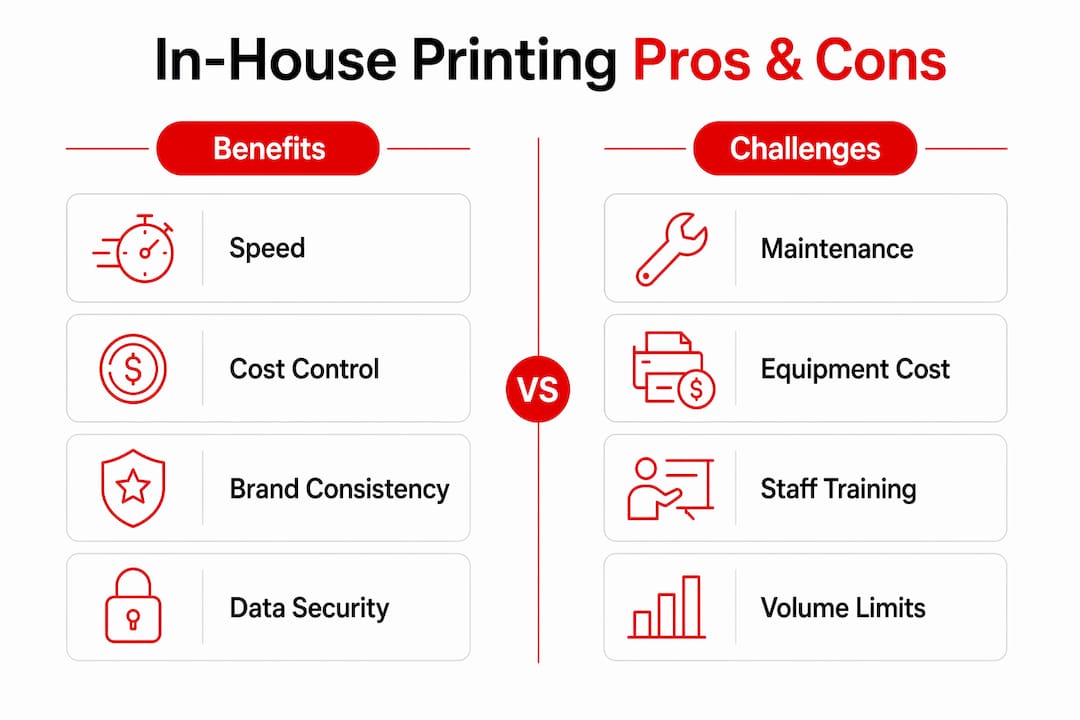
The decision between in-house printing and outsourcing comes down to three variables: volume, turnaround time, and complexity. No single answer fits every business, but the framework below makes the choice clear.
| Scenario | Best approach |
|---|---|
| Frequent short runs, urgent deadlines | In-house printing |
| High-fidelity brand collateral, complex finishing | Outsource to a specialist |
| Confidential or sensitive documents | In-house printing |
| Large-volume offset print jobs | Outsource for cost efficiency |
| Prototyping and product sampling | In-house printing |
| Wide-format trade show displays | Evaluate hybrid approach |
A hybrid model is the most practical answer for most small businesses. Use in-house production for speed and flexibility on everyday jobs. Send complex, high-fidelity projects to a specialist when brand standards demand it. This approach keeps costs down without sacrificing quality on the jobs that matter most.
Total Cost of Ownership is the metric that makes or breaks this decision. Beyond the equipment purchase or lease, you must account for ink, toner, substrates, software licenses, and staff time. Neglecting any of these can erase the savings you expected from bringing production in-house.
Pro Tip: Run a 90-day print audit before committing to new equipment. Track every print job by type, volume, and cost. The audit will show you exactly which jobs belong in-house and which ones should stay outsourced.
What are the limitations and challenges of managing in-house printing?
In-house printing is not the right answer for every job or every business. The limitations are real, and ignoring them leads to expensive mistakes.
- Upfront capital costs are significant. Quality production equipment carries a substantial purchase price or lease commitment. That investment only pays off if your volume justifies it.
- Hidden costs accumulate fast. Ink, toner, specialty substrates, calibration tools, and replacement parts add up monthly. Without a service agreement, unpredictable repair bills can disrupt your budget without warning.
- Color accuracy is harder than it looks. Achieving consistent, brand-accurate color across different substrates requires calibrated equipment, color profiles, and trained operators. Uncalibrated machines drift over time and produce inconsistent results.
- Finishing options are limited. Most small in-house setups cannot match the foil stamping, die-cutting, or specialty coating options available from commercial print shops. For premium brand collateral, those limitations show.
- Staff time is a real cost. Someone has to operate, maintain, and troubleshoot the equipment. That time has a dollar value, and it rarely appears in the initial cost estimate.
- Quality inconsistency damages your brand. Poorly managed in-house printing produces results that look unprofessional. A single bad batch of branded materials can undercut months of brand-building work.
The honest reality is that in-house printing is not one-size-fits-all. Matching print jobs to the right production method by volume, complexity, and turnaround time is what separates profitable in-house operations from expensive ones.
How can businesses optimize their in-house printing setup?
Optimization starts with a service agreement. Bundled service agreements cover supplies, parts, maintenance, and proactive remote monitoring for a predictable monthly fee. They replace surprise invoices with clear budget forecasting, which is exactly what a small business needs to plan confidently.
Workflow automation and digital asset management are the next layer. Automation reduces manual errors, speeds up job processing, and makes print-on-demand practical at scale. A digital asset library ensures every team member pulls the correct, approved file rather than an outdated version.
Staff training is non-negotiable. Your equipment is only as good as the person operating it. Invest in proper onboarding for anyone who touches the production workflow, including basic color management, file handling, and equipment care. Pair that training with a quality control checklist that every job passes through before it ships.
Right-sizing your equipment matters as much as the equipment itself. A machine built for 10,000 impressions per month running at 500 is an expensive underutilization. A machine built for 500 running at 5,000 will break down constantly. Match capacity to your actual volume, with room to grow.
Pro Tip: Treat your in-house print operation as a revenue-generating asset, not just a cost center. Businesses that insource external print work and expand into value-added services like promotional products often find that the operation pays for itself faster than expected.
Key Takeaways
In-house printing delivers the most value when volume is consistent, turnaround time is critical, and brand control matters more than complex finishing.
| Point | Details |
|---|---|
| Speed is the top advantage | In-house production cuts turnaround from days to hours for short-run and urgent jobs. |
| Cost control requires a service agreement | Bundled agreements replace unpredictable repair bills with a fixed monthly spend. |
| Hybrid models work best | Use in-house for speed and flexibility; outsource complex, high-fidelity projects. |
| Total Cost of Ownership is the real metric | Factor in supplies, staff time, and maintenance before comparing in-house to outsourcing costs. |
| Match jobs to the right method | Volume, complexity, and turnaround time determine whether a job belongs in-house or outside. |
Why I think most small businesses underestimate in-house printing
Most small business owners I talk to think of in-house printing as a cost-saving measure. That framing is too narrow, and it leads to bad decisions.
The real value is operational agility. When you control your own production, you can respond to a last-minute event, fix a design error, or test a new product idea without waiting on a vendor’s schedule. That speed compounds over time. Businesses that can move fast consistently outperform those that cannot, regardless of industry.
The mistake I see most often is buying equipment without auditing the workflow first. A great machine in a broken process still produces bad results. The businesses that get in-house printing right treat it like any other operational investment: they map the workflow, identify the bottlenecks, and then choose equipment that solves a specific problem.
I also think the hybrid model is underused. There is no rule that says you must do everything in-house or everything outside. The advantages of fast turnaround apply to specific job types, not every job type. Knowing the difference is what separates a profitable print operation from an expensive one.
The businesses I respect most in this space treat their in-house setup as a growth driver. They insource work that used to go to outside vendors, they add new product categories like small batch custom apparel, and they use that capability to serve customers faster than the competition. That is the mindset shift that makes in-house printing worth the investment.
— Aaron
Custom printing solutions from Handmadeohiocrafts
Handmadeohiocrafts designs and produces every order in-house from its Waverly, Ohio facility, which means the same speed and quality control described in this article applies directly to your order.
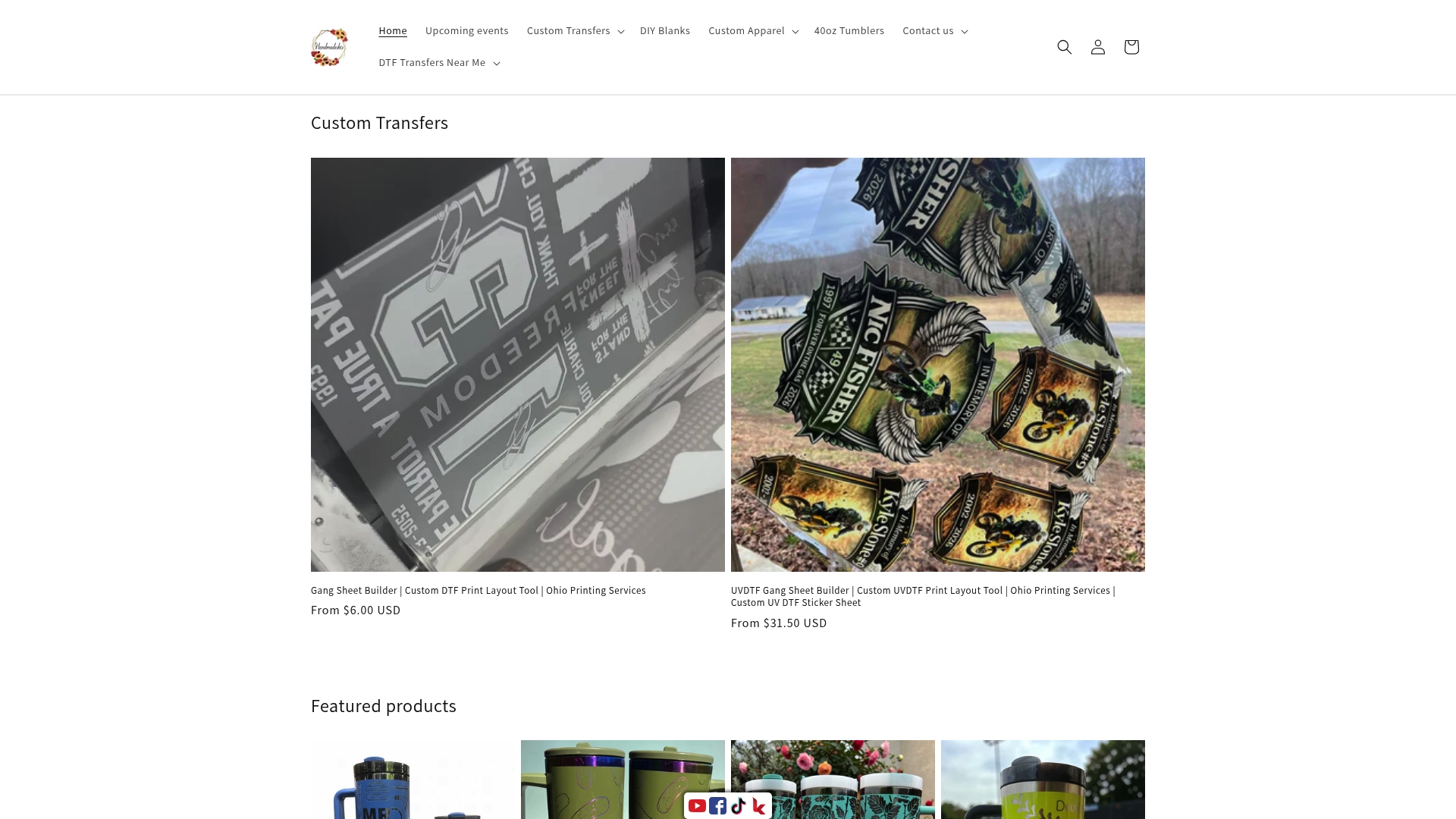
Whether you need custom apparel for a team, event, or brand campaign, or you want to apply a design using DTF transfers to your own garments, Handmadeohiocrafts handles the full production process without minimum order requirements. Every product ships nationwide, and the in-house model means faster turnaround and direct quality oversight on every job. If you have a project in mind, Handmadeohiocrafts makes it straightforward to get from idea to finished product.
FAQ
What is in-house printing in simple terms?
In-house printing is the practice of producing printed materials inside your own organization using owned or leased equipment, rather than sending jobs to an outside vendor. It gives businesses direct control over speed, cost, and quality.
How does in-house printing save money?
In-house printing replaces fluctuating vendor pricing with predictable cost-per-page models and eliminates outsourcing markups. Savings are highest for businesses with consistent, high-frequency print volume.
What types of jobs are best suited for in-house printing?
Short-run jobs, urgent prints, internal documents, prototypes, and branded promotional items are the strongest candidates. Complex finishing and high-fidelity brand collateral often still benefit from outsourcing.
What equipment do small businesses typically use for in-house printing?
Common options include digital inkjet printers, DTF transfer printers, laser printers, and laser engravers. The right choice depends on the substrate, volume, and type of product you need to produce.
Is in-house printing worth it for very small businesses?
It depends on print volume and frequency. A 90-day print audit that tracks job types, quantities, and current costs is the most reliable way to determine whether in-house production will pay off for your specific operation.