

Product Branding Decals: What They Are and How to Use Them
A product branding decal is a printed graphic applied directly to a product surface, packaging, or promotional item to communicate brand identity. Think of it as a portable logo placement: a vinyl or UV DTF decal carrying your logo, tagline, or brand colors, stuck to a tumbler, mailer box, or trade show giveaway. If you need to put your brand on a physical object without printing directly onto it, a branding decal is usually the fastest and most cost-effective way to do it.
Core uses at a glance:
- Branding product surfaces (tumblers, bottles, electronics, tools)
- Packaging accents on boxes, bags, and mailers
- Promotional giveaways and event inserts
- Retail shelf differentiation and limited-edition product drops
A product-branding decal does one thing a logo file cannot: it puts your brand in someone’s hand, on their desk, or on their car — and keeps it there.
Handmadeohiocrafts produces UV DTF decals and custom promotional products in-house in Waverly, Ohio, with no minimum order requirements and nationwide shipping.
Key Takeaways
A product-branding decal is the most direct way to put a brand identity on a physical product surface, and material choice, file prep, and placement determine whether it lasts a season or several years.
| Point | Details |
|---|---|
| Definition | A branding decal is a printed, adhesive-backed graphic applied to a product surface to communicate brand identity. |
| Material match | Choose UV DTF for hard curved surfaces; laminated vinyl for outdoor flat surfaces; static cling for temporary window use. |
| Lifespan factors | UV exposure, dishwasher cycles, and chemical contact shorten decal life; lamination extends it for outdoor applications. |
| File readiness | Submit 300 DPI files in CMYK with 0.125-inch bleed and white-ink flags to avoid production delays. |
| Handmadeohiocrafts | Produces UV DTF decals and custom promotional products in-house with no minimums and nationwide shipping. |
Table of Contents
- What exactly is a product branding decal?
- How do decals boost brand visibility and customer engagement?
- Stickers vs. labels vs. decals: what’s the real difference?
- Which decal materials work best for product branding?
- Design, sizing, and placement best practices
- Functional uses: safety marks, compliance labels, and serial decals
- How long do product-branding decals last?
- How to order custom product-branding decals: file specs and turnaround
- Why Handmadeohiocrafts recommends decals for certain product lines
- Handmadeohiocrafts produces UV DTF decals and custom branded products in-house
- Sources
What exactly is a product branding decal?
Product branding is the process of creating a unique identity for a standalone product through design and messaging that shapes consumer perception and loyalty. A product-branding decal is the physical execution of that identity at the product level: a printed, adhesive-backed graphic that turns any surface into a brand touchpoint.
That distinction matters. A corporate brand mark lives in a style guide. A product-branding decal lives on the object your customer actually touches.
Decals operate as mini-brand ambassadors. A logo decal on a 40oz tumbler travels to coffee shops, gyms, and offices, generating impressions the original sale never anticipated.
Where decals sit relative to other brand assets:
- Packaging covers the outer container and is usually discarded. A decal on the product itself stays visible long after the box is gone.
- Labels are regulatory or informational by default (ingredients, barcodes, care instructions). Decals are primarily visual and brand-driven.
- Corporate brand marks live in digital and print media. Decals translate those marks onto three-dimensional surfaces.
- Promotional stickers are similar in format but typically handed out loose rather than applied to a specific product.
The emotional driver is straightforward: product branding uses visuals and messaging to create connections that influence purchases and loyalty. A well-placed decal on a product someone uses daily reinforces that connection every time they reach for it.
How do decals boost brand visibility and customer engagement?
Decals and stickers are cost-effective, portable, and customizable tools that increase brand recognition across many surfaces, reaching audiences repeatedly without ongoing media spend. That’s the core marketing argument for them: one print run, indefinite impressions.
Sticker marketing and custom decals increase brand visibility through distribution tactics that convert customers into physical brand advocates. The key insight from that research is framing: designs that function as lifestyle badges rather than blunt advertisements get voluntarily displayed, which multiplies organic reach without additional cost.
Practical marketing benefits:
- Earned impressions. A decal on a customer’s laptop or water bottle generates repeated brand exposures in new environments.
- Physical presence. Unlike a digital ad, a decal cannot be scrolled past or blocked.
- Lifestyle association. A well-designed decal signals community membership, which is why brands from craft breweries to outdoor gear companies give them away at events.
- Package inserts. Dropping a branded decal into every order gives customers something to keep and display, extending the brand beyond the purchase moment.
Real-use examples worth noting: a small coffee roaster adds a logo decal to each bag’s heat-seal; a fitness brand ships a decal sheet with every supplement order; a local brewery hands out die-cut logo decals at tap room events. Each placement creates a mobile impression that paid advertising cannot replicate at the same cost.
QR codes applied to decals can bridge physical products to digital experiences, enabling product registration, promotional scans, and scan-to-learn behaviors. Adding a scannable code to a branding decal turns a passive impression into a measurable interaction.
For promotional sticker printing, the most effective campaigns pair premium materials with targeted distribution: limited drops at events, inserts in subscription boxes, and giveaways tied to product launches.
Stickers vs. labels vs. decals: what’s the real difference?
The main difference is intended permanence and function. Decals are designed to adhere to a specific surface for an extended period. Stickers are typically short-term or promotional. Labels carry regulatory or informational content and must meet specific format requirements.
| Format | Intended use | Adhesive | Finish options | Cost profile | Regulatory fit |
|---|---|---|---|---|---|
| Branding decal | Product surface identity | Permanent or removable | Gloss, matte, clear, white | Moderate | Not suitable for compliance |
| Packaging label | Product info, barcodes, ingredients | Permanent | Gloss, matte | Low to moderate | Yes, with correct specs |
| Promotional sticker | Giveaways, events, inserts | Removable or light-tack | Gloss, matte, die-cut | Low | No |
A logo decal on a powder-coated steel tumbler is a branding decal. The nutrition facts panel on a supplement bottle is a label. The free sticker tucked into an online order is a promotional sticker. All three use adhesive-backed print, but the job each one does is different enough that choosing the wrong format creates real problems, whether that’s a compliance gap or a decal that peels off in a dishwasher.
Which decal materials work best for product branding?
Choose your material based on the surface it will live on and how long it needs to last. A decal going on a dishwasher-safe tumbler needs different specs than one applied to a storefront window or a powder-coated fleet vehicle.
| Material | Pros | Cons | Best uses |
|---|---|---|---|
| Cast vinyl | Conforms to curves, 5–7 year outdoor life | Higher cost | Vehicle wraps, curved product surfaces |
| Calendered vinyl | Affordable, good indoor durability | Less conformable, 2–4 year outdoor life | Flat surfaces, indoor product branding |
| Laminated vinyl | Abrasion and UV resistant | Adds thickness | Outdoor products, fleet decals |
| UV DTF | Photo-quality on hard surfaces, no weeding | Requires smooth substrate | Tumblers, bottles, electronics, promo gifts |
| Static cling | Repositionable, no adhesive | Low durability | Window displays, short-term use |
| Clear film | Invisible background effect | Requires white-ink base for color accuracy | Glass, clear packaging |
Material selection and protective lamination materially affect decal longevity, abrasion resistance, and traceability. In practice, lamination often does more for outdoor lifespan than print resolution does.
Removable vs. permanent adhesive: Permanent adhesive bonds aggressively and resists moisture, heat, and UV. Removable adhesive allows clean repositioning but may lift at edges in humid or high-heat environments. For product surfaces that will be handled daily, permanent adhesive is almost always the right call.
For UV DTF decals, white-ink printing is a practical necessity on colored or clear substrates. Without an opaque white base layer, colors print translucent and lose contrast against anything other than a white surface.
Pro Tip: Match adhesive to substrate chemistry. Powder-coated steel and coated plastics need aggressive permanent adhesive. Textured or porous surfaces (raw wood, fabric) rarely hold any pressure-sensitive adhesive well — consider heat-applied DTF transfers instead. Glass and smooth metal are ideal for UV DTF.
Design, sizing, and placement best practices
Legibility, contrast, and scale for the product context come first. A design that looks sharp at 12 inches on a monitor can become unreadable at 2 inches on a product surface.
- Set minimum type size at 8pt for print. Anything smaller risks filling in or becoming illegible after lamination.
- Use high-contrast color combinations. Dark ink on light backgrounds (or vice versa) reads at distance and in low light.
- Keep stroke widths at 1pt minimum. Hairline strokes disappear in production.
- Add 0.125-inch bleed on all sides for die-cut decals so edge colors don’t show white borders after cutting.
- Maintain a 0.0625-inch safe area inside the cut line to keep critical elements from being trimmed.
- Simplify for scale. A logo with fine gradients or complex shadows may need a simplified version for small decal applications.
- Avoid centered placement by default. Front-center placement reads as generic. Bottom-corner or interior-edge placement can feel more intentional and premium.
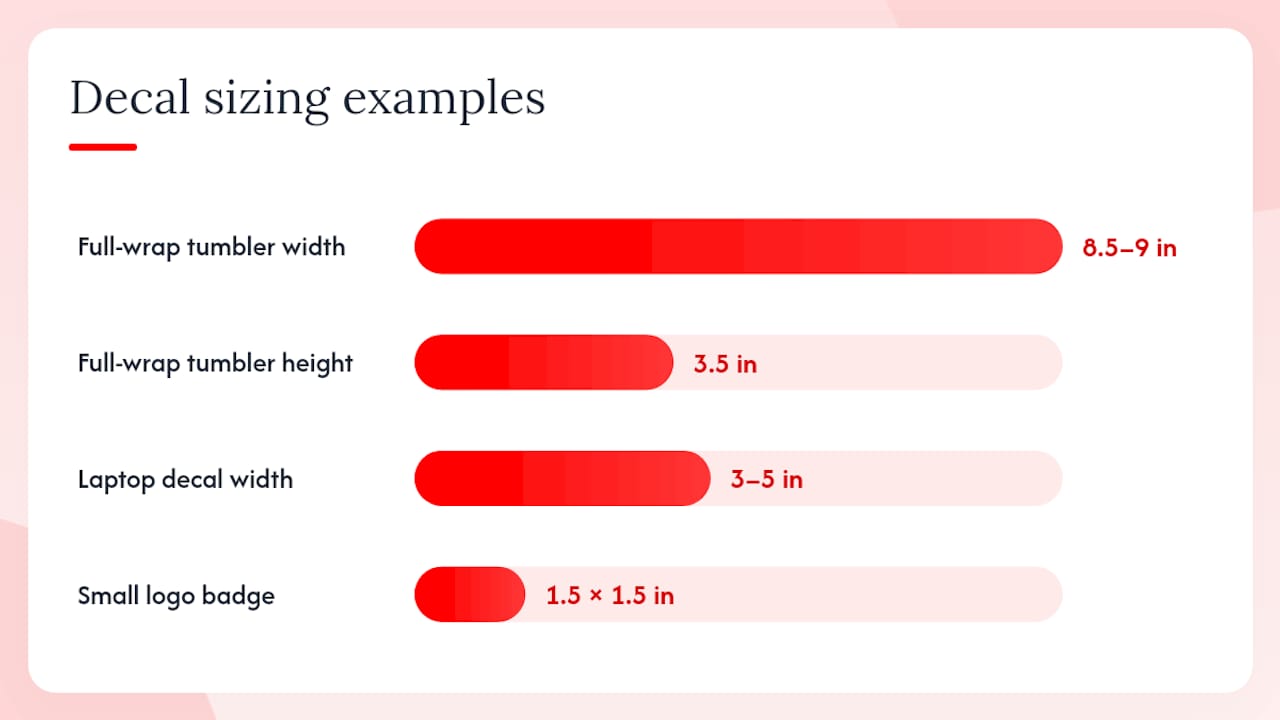
Sizing examples: a full-wrap tumbler decal typically runs 3.5 inches tall by 8.5–9 inches wide to cover a standard 20–40oz tumbler. A small logo badge for a product surface might be 1.5 by 1.5 inches. A laptop decal commonly lands between 3 and 5 inches wide.
Placement changes perceived value. A decal centered on the front of a product reads as a label. The same decal placed at a slight offset, or on the bottom of a product near a serial number, reads as a design decision. Interior packaging placement, like a decal on the inside lid of a box, creates a moment of discovery that customers remember and photograph.
Functional uses: safety marks, compliance labels, and serial decals
Decals also serve product-critical roles that have nothing to do with marketing. Safety labels, compliance markings, serial number plates, and tamper-evident seals are all decal applications where durability and legibility are regulatory requirements, not aesthetic preferences.
Common functional use cases:
- Warning and safety labels on equipment, tools, and electrical products
- Serial number and QR code decals for product registration and traceability
- Tamper-evident decals that show visible damage if removed
- Fleet and vehicle compliance markings for DOT, OSHA, or industry-specific requirements
- Instructional decals on machinery, appliances, and consumer electronics
Fleet and vehicle decals used for safety and compliance require specific materials and application best practices to remain legible and durable in field conditions. The same principle applies to any product-mounted safety decal: material choice, adhesive strength, and lamination all affect whether the label stays readable over the product’s service life.
If your product requires safety or compliance markings, confirm the applicable standards with the relevant regulatory body (OSHA, UL, ANSI, or your industry’s governing organization) before specifying materials. A branding decal and a compliance label may look similar, but they carry different performance requirements.
How long do product-branding decals last?
Lifespan varies by material, finish, adhesive, and environment. As a working baseline: indoor decals on protected surfaces last several years with normal handling. Outdoor decals on unprotected surfaces typically last multiple years depending on UV exposure, temperature cycling, and whether a protective laminate was applied.
Factors that shorten decal life:
- UV exposure without lamination. Unlaminated decals fade faster outdoors, sometimes within a single season in high-sun climates.
- Dishwasher cycles. Standard vinyl and most adhesives degrade with repeated high-heat washing. UV DTF decals on tumblers hold up better but still have limits.
- Chemical exposure. Cleaning solvents, oils, and alcohol-based products attack adhesive bonds and print layers.
- Surface flex. Decals on flexible substrates crack over time as the material bends.
- Improper installation. Air bubbles, edge lifting, and surface contamination at application all accelerate failure.
Maintenance steps:
- Clean the surface with isopropyl alcohol before applying a new decal.
- Wipe decals with a damp cloth only; avoid abrasive scrubbers.
- Keep decaled surfaces out of prolonged direct sunlight when possible.
- For tumblers, hand-wash rather than dishwasher-wash to extend decal life.
Removal: Apply low heat (a hair dryer works) to soften the adhesive, then peel slowly from one corner at a 45-degree angle. Remove adhesive residue with isopropyl alcohol or a commercial adhesive remover. On painted or powder-coated surfaces, test the remover in an inconspicuous spot first.
How to order custom product-branding decals: file specs and turnaround
Before you submit artwork, confirm these specs. Missing one of them is the most common cause of production delays.
File-spec checklist:
- File format: PDF, AI, EPS, or high-resolution PNG (300 DPI minimum at final print size)
- Color mode: CMYK for standard print; include Pantone references if color accuracy is critical
- Resolution: 300 DPI at 100% of final output size
- Bleed: 0.125 inch on all sides for die-cut decals
- Safe area: Keep text and critical elements 0.0625 inch inside the cut line
- White ink: Flag any areas requiring a white-ink base layer (required for clear or colored substrates)
- Spot colors: Call out any metallic or specialty inks separately
For detailed artwork setup, the DTF file requirements guide covers color mode, resolution, and bleed specs that apply to both DTF transfers and decal orders.
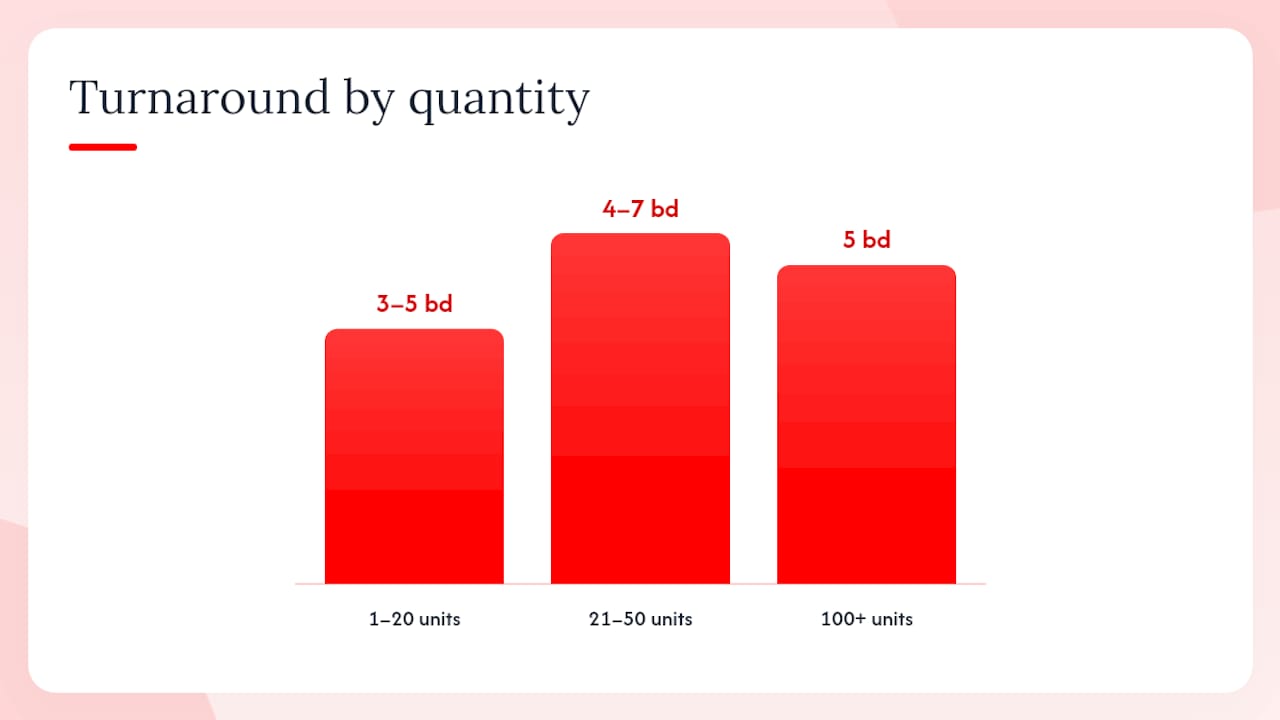
| Quantity | Typical turnaround | Notes |
|---|---|---|
| 1 to 20 units | 3–5 business days | Standard in-house production |
| 21 to 50 units | 4–7 business days | Gang sheet layout may apply |
| 100+ units | 5 business days | Custom quote recommended |
Pricing varies by size, material, finish, and quantity. UV DTF decals for small product branding applications (under 4 inches) typically run in the range of a few dollars per unit at low quantities, with per-unit cost dropping as quantity increases. Request a quote for accurate pricing on your specific specs.
Pro Tip: The single fastest way to speed up production is to submit print-ready files. Artwork that arrives as a low-resolution JPEG or a Word document requires a redesign step that adds days. Submit vector files or 300 DPI PNGs with bleed, and your order moves straight to production. The most common delay after artwork is custom color approval — if Pantone matching matters, say so upfront.
For fast turnaround custom printing, in-house production is the key variable. When design, printing, and finishing happen under one roof, there’s no handoff delay between vendors.
Why Handmadeohiocrafts recommends decals for certain product lines
Decals are the right call when a client needs brand presence on a hard surface without committing to a full product redesign or custom packaging run. That’s the honest reason Handmadeohiocrafts recommends them so often for tumblers, promotional gifts, and retail product samples.
The most common project types: UV DTF decals for branded tumblers and drinkware, die-cut logo decals for event giveaway packs, and product-surface branding for small-batch retail items. For tumblers specifically, a UV DTF decal applied to a laser-engravable blank gives a client two branding options on the same product: a permanent engraved mark and a full-color decal accent.
Quality control at Handmadeohiocrafts runs through every stage: artwork review before production, substrate testing for new material combinations, and a visual check before shipping. No minimum order means a client can order a single sample decal to test placement and adhesion before committing to a larger run.
Handmadeohiocrafts produces UV DTF decals and custom branded products in-house
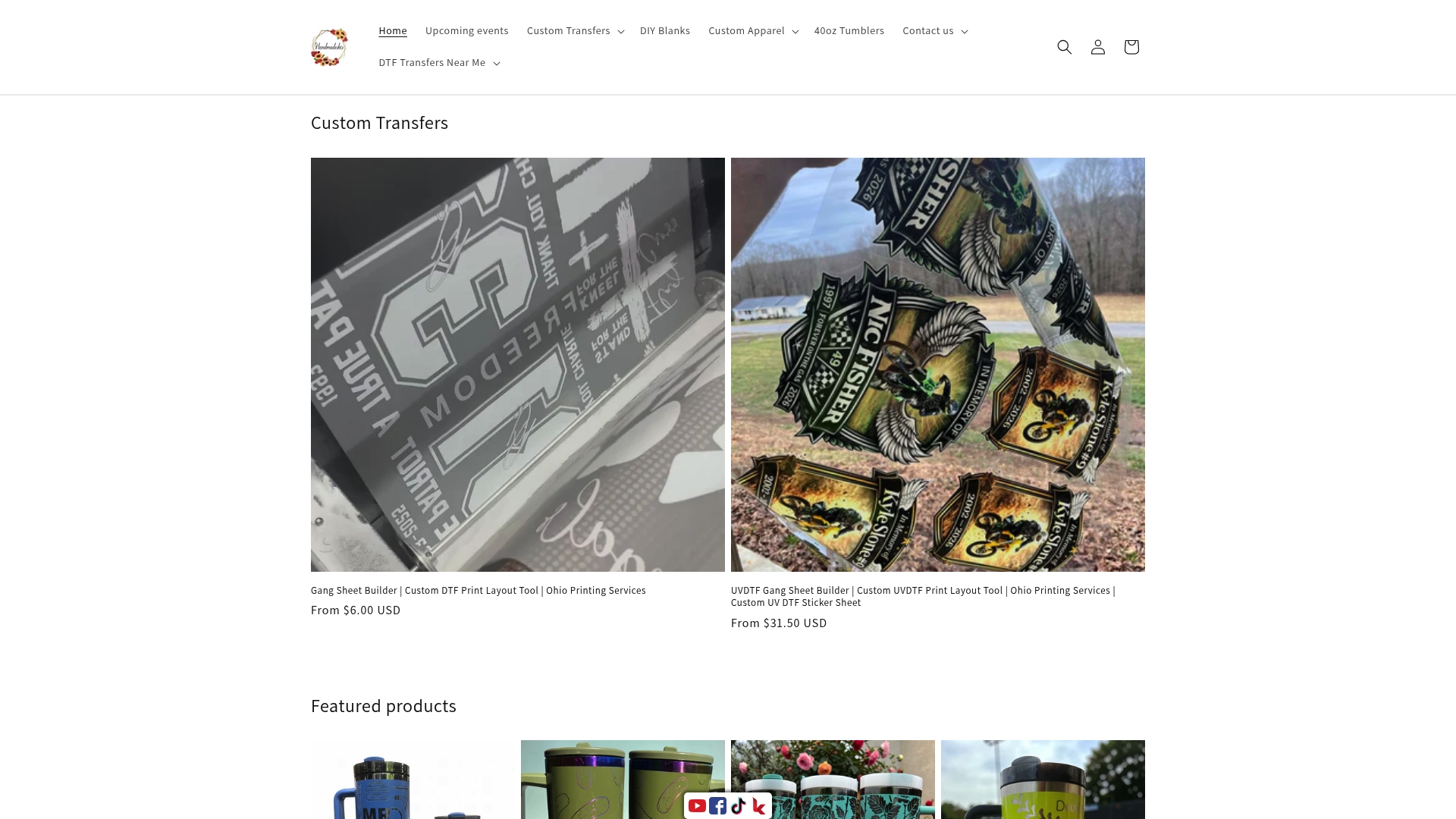
Skip the back-and-forth with a print broker. Handmadeohiocrafts designs and produces UV DTF decals and custom promotional products entirely in-house in Waverly, Ohio, which means faster turnaround, direct communication, and no minimum order requirements.
What Handmadeohiocrafts offers for product branding:
- UV DTF decals for hard surfaces (tumblers, bottles, electronics, promo gifts)
- DTF transfers for apparel and fabric surfaces
- Laser engraving on tumblers, gifts, and promotional blanks
- Custom promotional products with no minimum order
- Nationwide shipping with fast in-house production
Ready to put your brand on a product? Upload your artwork or request a quote directly at Handmadeohiocrafts and get a production-ready proof before your order goes to print.
Sources
- Product Branding: 2026 Guide to Creating an Unforgettable Product - Shopify
- Guide to Sticker Marketing & Custom Decals for Business
- Fleet vehicle labeling safety, compliance and application best practices - Trident Products
- Durable labels: the overlooked driver of product quality and traceability - Quality Magazine
- 5 Benefits of Using Decals and Stickers | Artcraft Sign