

Promotional Sticker Printing: A Small Business Guide
Promotional sticker printing is the process of producing custom adhesive graphics designed to promote a brand, product, or event. Unlike regulatory labels, promotional stickers are built to be kept, displayed, and shared — they carry your logo, colors, and message into the world on laptops, water bottles, storefronts, and packaging.
Common uses at a glance:
- Giveaways at events, markets, and trade shows
- Package inserts tucked into e-commerce orders
- Branded swag for schools, teams, and nonprofits
- Event handouts and direct-mail campaigns
The appeal for small businesses is straightforward: stickers cost very little per unit, yet every time someone sticks one somewhere, your brand gets a free impression.
Table of Contents
- What counts as a promotional sticker?
- What materials and finishes should you choose?
- How are promotional stickers actually produced?
- How do you set up files for sticker printing?
- How much does promotional sticker printing cost?
- Where do promotional stickers work best?
- How do you place a sticker order from start to finish?
- What trends are changing sticker printing for small businesses?
- Key Takeaways
- Why stickers punch above their weight
- Handmadeohiocrafts makes custom sticker printing straightforward
What counts as a promotional sticker?
A promotional sticker exists to build brand awareness or drive engagement. A label exists to inform — think ingredient lists, shipping addresses, or safety warnings. The distinction matters when you are ordering, because promotional stickers are typically printed on higher-quality stock with richer color and more finish options than plain functional labels.
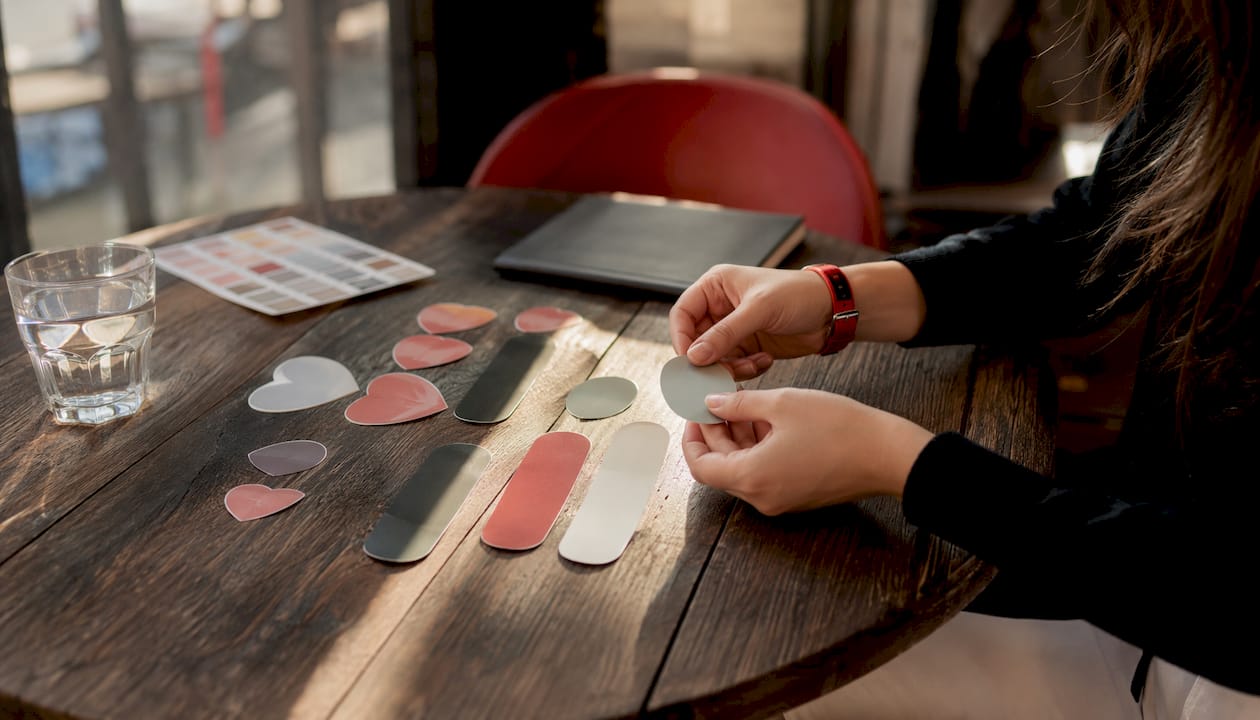
Promotional stickers come in several formats, each suited to a different distribution method:
| Format | Best for | Distribution method |
|---|---|---|
| Die-cut singles | Giveaways, swag packs | Hand out individually |
| Kiss-cut sheets | Retail displays, mailers | Peel-and-use convenience |
| Roll labels | Product packaging, dispensers | Machine or hand application |
| Sticker postcards | Direct mail, event packets | Mail or hand-deliver |
Die-cut singles are cut to the exact shape of the design — a star, a logo, a character. They feel premium and photograph well, which makes them popular for brand swag. Kiss-cut sheets leave the sticker on its backing until the recipient peels it off, so they survive mailing without curling. Rolls are the format of choice when you are sealing hundreds of packages a day or running a labeling machine. Sticker postcards combine a printed card with peel-off stickers, giving recipients something to keep and something to read.
What materials and finishes should you choose?
Material choice is the single biggest factor in how long a sticker survives and how it looks. Here is a practical breakdown:
| Material | Best uses | Pros | Cons |
|---|---|---|---|
| Coated paper | Indoor handouts, mailers | Low cost, easy to write on | Not waterproof |
| Matte vinyl | Indoor/outdoor branding, laptops | Durable, no glare | Slightly higher cost |
| Gloss vinyl | Packaging, product labels | Vivid color, moisture-resistant | Can show fingerprints |
| BOPP/film | Outdoor decals, bottles | Weatherproof, tear-resistant | Higher cost |
| Clear film | Window clings, bottle labels | See-through effect | Requires spot white ink |
Finishes add another layer of control. A gloss laminate deepens color and protects against scuffs. Matte laminate gives a flat, tactile feel that reads as premium. Soft-touch laminate is the velvet option — expensive but memorable on high-end packaging. UV coating adds a hard, shiny shell that resists scratches and moisture. For most small-business uses, a standard gloss or matte vinyl with aqueous coating hits the sweet spot between cost and durability.
Outdoor stickers need vinyl or BOPP with UV-resistant inks. Indoor paper stickers are fine for handouts and mailers but will not survive rain or a dishwasher cycle.
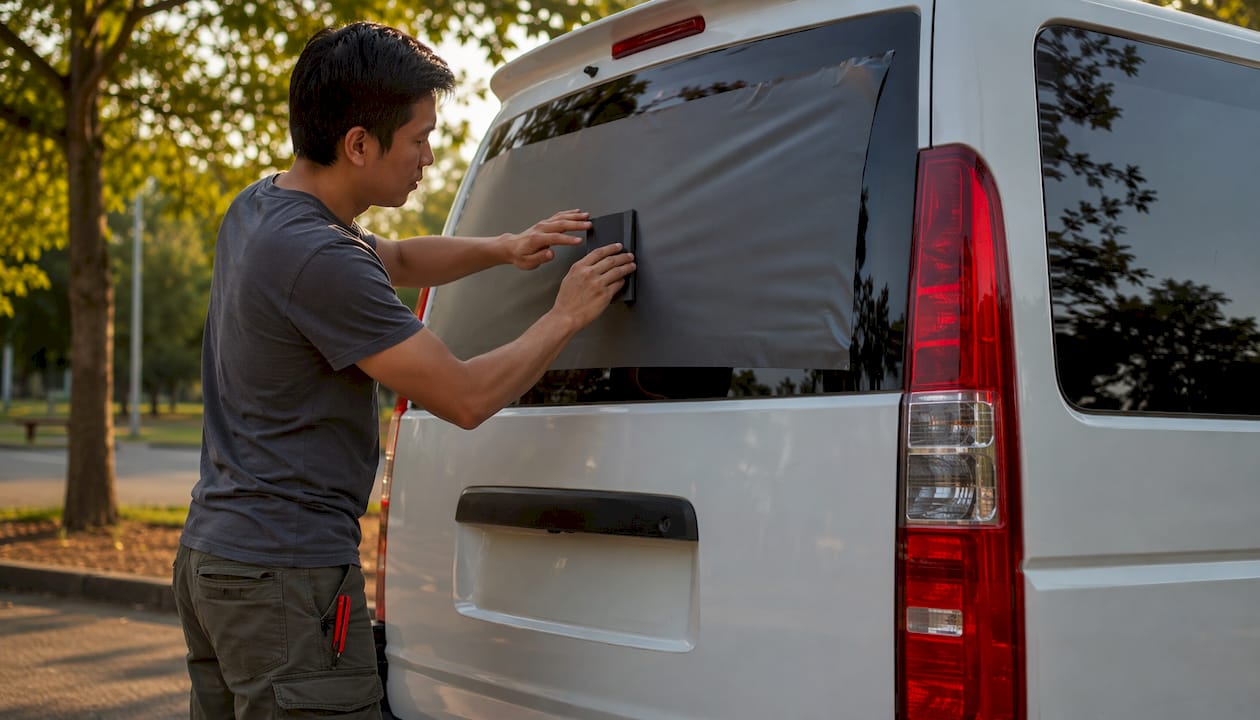
Pro Tip: Match the minimum material spec to the job. If your stickers are going into a mailer that recipients will open once and stick on a notebook, coated paper saves real money. Save vinyl for anything that will live outdoors or on a product that gets handled daily.
How are promotional stickers actually produced?
Most small-run custom stickers are printed digitally, using inkjet or UV flatbed presses. Digital printing requires no printing plates, so minimums can be as low as a single sheet. Color accuracy is excellent, and turnaround is fast — often 2–5 business days for standard orders.
Screen printing and offset lithography enter the picture at higher volumes, typically in the thousands. They lower the per-unit cost significantly but require setup fees and longer lead times. Screen printing also opens the door to specialty inks: metallics, fluorescents, and true Pantone spot colors that digital presses approximate but do not always nail.
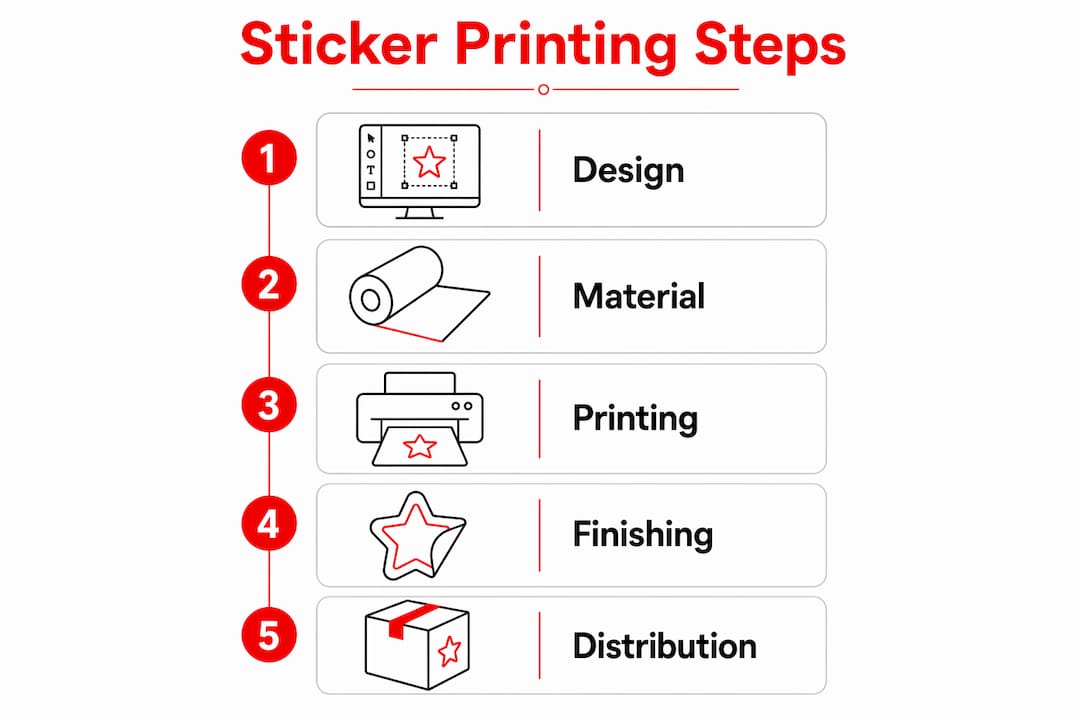
Production workflow breaks into two paths:
- Sheet production: stickers are printed on flat sheets, then die-cut or kiss-cut. Best for handouts, retail displays, and mailers.
- Roll production: stickers are printed and wound onto a roll for use with dispensers or labeling machines. Best for product packaging and high-volume application.
Pro Tip: Before committing to a large run, order a physical proof or a small sample set of 10–25 pieces. Colors shift between screen and print, and a laminate that looks subtle on a monitor can look very different on the actual stock. A $15 sample saves a $500 reprint.
For context on when screen printing makes more sense than digital for specialty runs, the tradeoffs come down to ink type and volume.
How do you set up files for sticker printing?
Send your printer a vector PDF or a high-resolution flattened file in CMYK, with the correct bleed and a clearly marked safe area. That one sentence covers 90% of file problems.
Here is the full checklist:
- Size and bleed: set your document to the finished sticker size, then add 0.125" bleed on all sides so the background extends past the cut line
- Safe area: keep all critical text and logos at least 0.0625"–0.125" inside the cut line
- Resolution: raster elements (photos, textures) at 300 dpi minimum at final print size
- Color profile: CMYK, or the specific ICC profile your printer specifies; RGB files will shift on press
- Fonts: outline all fonts before saving to avoid substitution errors
- Transparent backgrounds: supply a PNG or PDF with a transparent background if you are printing on clear stock
- Spot white: if printing on clear or metallic film, include a separate spot white layer so the design is opaque
- Dieline: for die-cut and kiss-cut orders, include the cut path on a separate layer labeled “dieline” in a spot color (usually magenta)
Accepted file formats vary by printer, but PDF/X-1a is the safest choice for press-ready files. PNG and TIFF work for digital print shops that handle the prepress themselves. EPS and SVG are fine for vector logos but less reliable as complete print files.
For a deeper look at artwork setup practices that apply across print methods, the same bleed and resolution rules carry over.
How much does promotional sticker printing cost?
Price is driven by six factors: quantity, size, material, finish, cut type, and turnaround. Understand those levers and you can control the budget.
Main cost drivers:
- Quantity: the biggest lever. Per-unit cost drops sharply as quantity rises because setup and plate costs spread across more pieces.
- Size: larger stickers use more material and more ink.
- Material: coated paper is cheapest; BOPP and specialty films cost more.
- Finish: adding laminate or UV coating adds cost per square inch.
- Cut type: kiss-cut and die-cut cost more than straight-cut because of the additional tooling step.
- Turnaround: rush production typically adds a fee.
Two rough examples to illustrate the quantity effect:
- Costs per sticker in small digital print runs tend to be higher than in large volumes.
- Larger run volumes typically lower the per-unit cost as setup costs are distributed over more pieces.
Those ranges are illustrative — actual quotes vary by supplier, region, and current material costs. Always get a written quote with shipping included.
Questions to ask before you commit to an order:
- What is the minimum order quantity?
- Is a digital proof included, and is a physical sample available?
- What is the standard production lead time, and what does rush cost?
- Does the price include shipping, or is that added at checkout?
- What is the color-matching policy if the printed result differs from the proof?
For small businesses that want to test before scaling, small-batch printing options make it practical to start with 50–100 pieces.
Where do promotional stickers work best?
Stickers are one of the most versatile marketing tools available to small businesses, and the best campaigns treat them as a passive distribution engine rather than a one-time giveaway.
Common use cases and what they deliver:
- E-commerce package inserts: a sticker tucked into every order costs pennies and turns customers into brand ambassadors when they stick it somewhere visible
- Event handouts: a well-designed sticker at a market or trade show travels home with the recipient and keeps your brand in front of them daily
- Retail counter displays: a small countertop dispenser encourages customers to take a sticker as a freebie, extending reach beyond the transaction
- Product packaging seals: a branded sticker sealing a tissue-paper wrap adds a premium feel without expensive custom packaging
- Direct mail: sticker postcards give recipients something physical to keep even after they read the card
Three quick campaign ideas for independent shops:
- The loyalty sticker: include a different sticker design with each order. Customers who collect all five designs share them on social media. Low cost, high organic reach.
- The collab drop: partner with a neighboring business to co-brand a sticker. Both shops distribute it, doubling the audience for the cost of one print run.
- The seasonal callout: print a limited-edition holiday sticker and include it only in orders during a four-week window. Scarcity drives social sharing.
For retail placement tactics, countertop dispensers and clear signage near the register consistently improve how many customers actually take a sticker.
Pro Tip: Stack stickers with receipts at checkout. Customers who are already in a positive transaction mindset are far more likely to take and use a branded freebie than someone who walks past a stack on a table.
How do you place a sticker order from start to finish?
Standard ordering runs in eight steps. The whole process from artwork to delivery typically takes 5–10 business days for digital production, longer for screen or offset.
- Prepare your artwork using the file checklist above: correct size, bleed, CMYK, 300 dpi, fonts outlined.
- Select material and finish based on where the sticker will live (indoor paper vs. outdoor vinyl) and your budget.
- Request a quote with quantity, size, material, finish, cut type, and turnaround clearly stated.
- Review the digital proof the printer sends back. Check colors, text, and cut line placement carefully.
- Approve or request a physical sample for large orders or new materials you have not printed before.
- Confirm the production timeline and any rush fees before paying.
- Pay or submit a deposit to release the job to production.
- Inspect the order on arrival — check a sample from different positions in the box for color consistency and cut accuracy.
Must-ask questions before approving production:
- What is the exact lead time from proof approval to ship date?
- How are color proofs handled — digital only, or physical available?
- What is the policy if the finished product differs significantly from the approved proof?
- Are rush fees flat or percentage-based?
Fast turnaround custom printing matters most when you are ordering for an event with a fixed date. Build in at least two extra days as buffer.
What trends are changing sticker printing for small businesses?
AI-assisted design tools and improved digital printing workflows have fundamentally shifted how small businesses should think about sticker campaigns. The old model was “pick one design, print a big run, hope it works.” The new model is “print three small batches of different designs, see which one gets stuck on things, then scale the winner.”
AI tools like Adobe Firefly let you generate multiple sticker design variations from a single prompt or logo in minutes. Combined with digital print-on-demand, you can have three distinct designs printed in runs of 100–200 each for roughly the cost of a single 500-piece run of one design. That is a real shift in how iteration works.
The practical implication: small businesses no longer need a professional designer and a large budget to test whether a sticker campaign resonates. A decent prompt, a free design tool, and a short-run digital printer get you to market fast.
Pro Tip: Run a simple A/B test with two sticker designs in your next 200 e-commerce orders. Split them evenly, then track which design shows up in customer photos on social media over the following month. The result tells you which visual direction to scale.
Key Takeaways
Promotional sticker printing gives small businesses a low-cost, high-visibility marketing tool that works across packaging, events, retail, and direct mail.
| Point | Details |
|---|---|
| Core definition | Promotional stickers are custom adhesive graphics made to promote a brand, not convey regulatory information. |
| Material choice | Match stock to use case: coated paper for indoor handouts, vinyl or BOPP for outdoor or product use. |
| Pricing lever | Quantity moves price more than any other factor; per-unit cost drops sharply as volume increases. |
| Ordering checklist | Prepare CMYK files with 0.125" bleed, 300 dpi raster art, outlined fonts, and a dieline for die-cut orders. |
| Handmadeohiocrafts | Produces custom stickers in-house with no minimums, fast turnaround, and nationwide shipping. |
Why stickers punch above their weight
Most small businesses underestimate how long a well-made sticker stays in circulation. A sticker on a laptop or water bottle gets seen by dozens of people every week, often for years. That is a media buy you cannot replicate with a Facebook ad at any price.
The mistake most first-time sticker buyers make is treating the design as an afterthought. They spend the budget on material and quantity, then slap a logo on a white circle. The stickers sit in a bowl at the register and nobody takes them. The businesses that get real mileage from stickers treat the design as seriously as any other piece of marketing: clear hierarchy, a single strong visual, and enough personality that someone actually wants to put it on their stuff.
The other underrated move is consistency. A sticker that matches your packaging, your social media aesthetic, and your store signage reinforces the brand every time it is seen. One that looks like it was designed separately from everything else does the opposite.
AI design tools lower the barrier to getting that consistency right, but they do not replace the judgment call about what your brand actually stands for. Use them to generate options fast, then edit with intention.
Handmadeohiocrafts makes custom sticker printing straightforward
Ordering custom stickers should not require a design degree or a large upfront commitment. Handmadeohiocrafts produces custom promotional products entirely in-house from Waverly, Ohio, which means shorter communication chains, faster turnaround, and direct quality control on every order.
There are no minimum order requirements, so you can start with a small test run, see how the design performs, and scale from there. File setup guidance is included, and the team can walk you through material and finish options before you commit. Nationwide shipping means it does not matter whether you are running a boutique in Columbus or a food truck in Portland.
Ready to get started? Request a custom quote or reach out directly to discuss your artwork, quantities, and timeline.