

Printing Setup Fees Explained: What You're Actually Paying For
A printing setup fee is a one-time charge that covers the physical work and materials required to prepare your artwork for production. Before a single shirt gets printed or a single flyer rolls off a press, a printer has to build something: a screen, a plate, a die, a digitized embroidery file. That preparation costs real money, and the setup fee is how shops recover it.
You’ll typically see this charge applied per color, per print location, or per production run. On a first order, it’s almost always there. On reorders, it depends entirely on the shop’s policy. Quick price-range context: digital printing setup runs roughly a low amount, while offset printing setup is significantly higher per run. Screen printing setup costs fall somewhere in between, billed per screen per color.
The concept that matters most for small buyers is the crossover point: the order quantity at which a high-setup method becomes cheaper per unit than a low-setup digital method. Below that threshold, digital wins on total cost. Above it, traditional methods pull ahead because the fixed setup cost spreads across more units.
- Setup fees are one-time or per-run, not per piece
- They cover prepress work, fixture creation, and machine preparation
- They vary significantly by printing method
- Digital methods (DTG, DTF) carry little to no setup cost
- Screen printing and offset printing carry the highest setup charges
Table of Contents
- What a setup fee actually covers
- Why printers charge setup fees at all
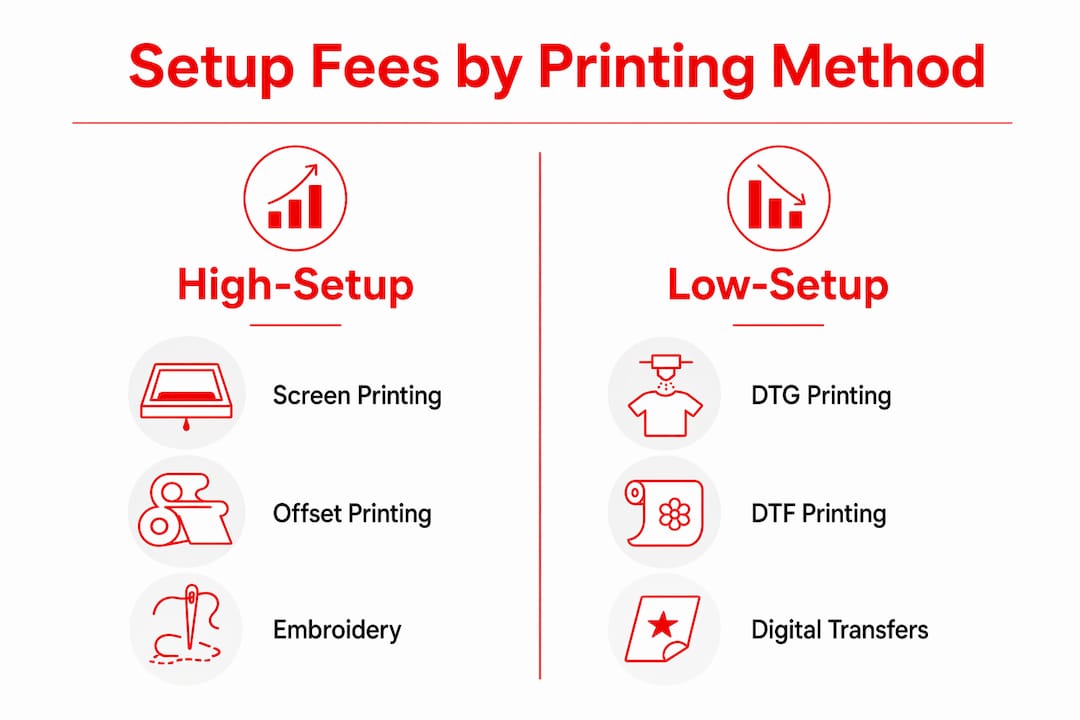
- How setup fees differ by printing method
- The crossover point: when does high-setup printing pay off?
- When multiple setup fees apply, and what happens on reorders
- How to reduce or avoid setup fees
- How Handmadeohiocrafts handles setup fees for small orders
- Key Takeaways
- The misunderstanding most buyers walk in with
- Handmadeohiocrafts cuts setup costs for small-batch orders
What a setup fee actually covers
A setup charge is the cost of creating the physical fixture used to apply your design: a screen, plate, dye, or die. But that’s the short version. The full list of what you’re paying for is longer.
- Artwork prep and file cleanup: Color separation, trapping, and converting your file into a format the press or printer can use. If you send a low-resolution JPEG, someone has to fix it.
- Fixture creation: For screen printing, that means burning a separate screen for each color. For offset, it’s plate-making. For heat transfer, it’s cutting film or creating a transfer sheet.
- Machine makeready: Calibrating the press, dialing in ink density, running test prints, and adjusting registration so colors align correctly.
- Consumables: Emulsion, film, exposure chemicals, and the waste material from test runs. These aren’t free, and they’re often bundled into the setup line item.
- Operator labor: Someone has to do all of the above. That time is billed whether your job runs 10 pieces or 10,000.
A screen printing shop, for example, might charge a per-screen fee for each color in your design. A two-color left-chest logo plus a one-color back print means multiple screens minimum, and potentially double if both locations use two colors each.
Why printers charge setup fees at all
Setup is a fixed cost. It happens once per job, regardless of how many units you order. A printer building a screen for your logo spends the same time whether you’re ordering 12 shirts or 500. That’s the core economic reality behind every setup charge.
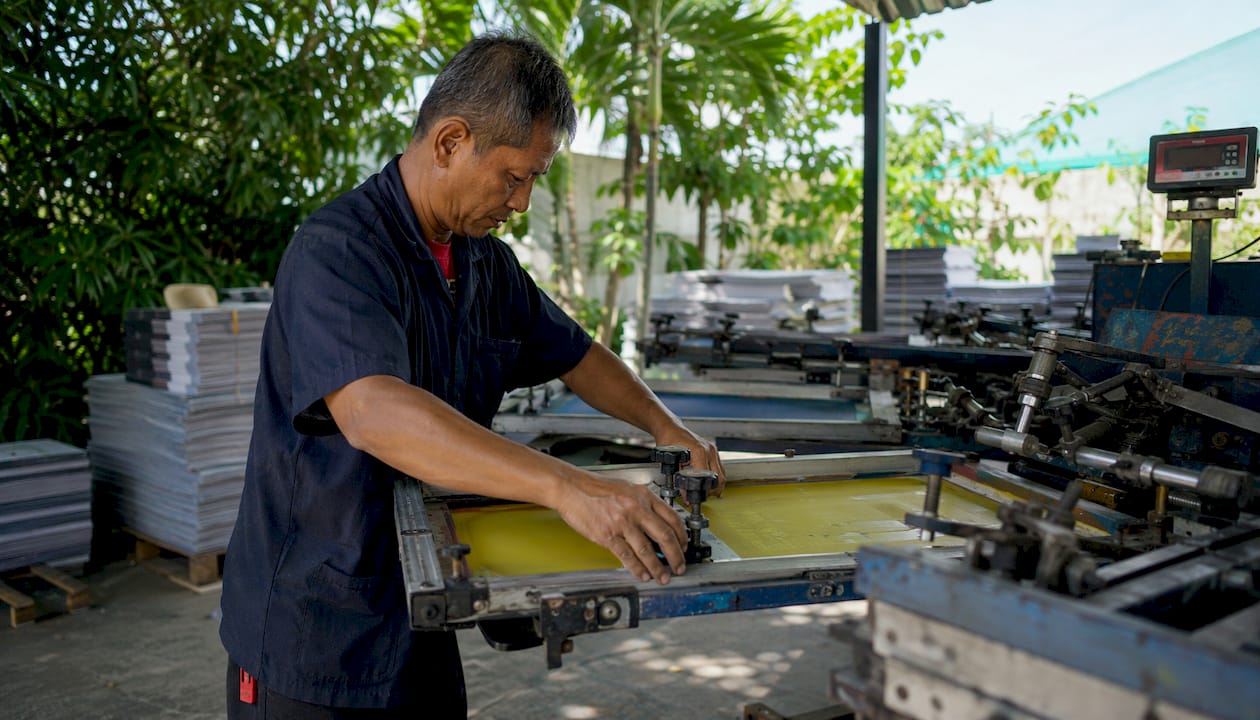
Printing costs follow an economy of scale: the setup is constant, but it gets divided across every unit produced. Order 500 shirts and a $150 screen fee adds $0.30 per shirt. Order 12 shirts and that same fee adds $12.50 per shirt. Same screen, very different per-unit impact.
There are also costs that sometimes hide inside a setup fee without being itemized: plate storage between runs, proofing rounds, and waste from calibration. Asking for a written breakdown of what’s included in the setup charge is one of the fastest ways to compare quotes fairly and catch fees that shouldn’t be there.
Pro Tip: Always ask your printer to break out the setup fee line by line: plates or screens, makeready, proofing, and consumables. A shop that can’t itemize it is a shop worth questioning.
How setup fees differ by printing method
Specific printing methods require special preparation before production can begin, and that preparation is what drives setup costs. The method you choose has a bigger impact on your total cost than almost any other variable.
| Printing Method | Typical Setup Cost | Best For |
|---|---|---|
| Screen printing | $30 per color per location | Large runs, bold graphics, few colors |
| Offset printing | significantly higher per run | High-volume flat print (flyers, catalogs) |
| DTG (direct-to-garment) | $0–$25 | Small runs, full-color photos on fabric |
| DTF (direct-to-film) | $0–$30 | Small batches, no minimums, transfers |
| Heat transfer | $10 per transfer design | Short runs, multi-substrate flexibility |
| Embroidery | digitizing fee | Hats, polos, structured garments |
Screen printing charges a separate screen for each color in your design. A four-color logo means four screens, and each print location on a garment triggers another round of screens. Screen printing setup is billed per color per location, so complexity stacks costs fast.
Offset printing front-loads the most cost of any method. Plate-making, press calibration, and waste from makeready all hit before a single finished piece comes off the press. It’s the right choice only when quantity is high enough to absorb those charges.
DTG and DTF are the closest thing to setup-free printing that exists at the shop level. No screens, no plates. A DTF transfer, for instance, is printed digitally and heat-applied, which means small-batch printing becomes genuinely affordable without a large minimum order.
Embroidery has its own version of setup: a digitizing fee to convert your artwork into a stitch file. Pay it once, and the file can be reused on future orders.
The crossover point: when does high-setup printing pay off?
The crossover point is the quantity at which a high-setup method becomes cheaper per unit than a low-setup alternative. Every buyer ordering custom apparel or promotional products should know roughly where that line sits for their job.
Here’s the basic formula:
Total cost = Setup cost + (Per-unit cost × Quantity)
Two worked examples using sourced figures:
-
Small run (25 shirts), one-color screen print vs. DTG
- Screen: $30 setup + ($4/shirt × 25) = $130 total ($5.20/shirt)
- DTG: $10 setup + ($7/shirt × 25) = $185 total ($7.40/shirt)
- Screen wins even at 25 units for a single-color design.
-
Tiny run (10 shirts), four-color design
- Screen: ($30 × 4 colors) + ($4/shirt × 10) = $160 total ($16/shirt)
- DTG: $10 setup + ($9/shirt × 10) = $100 total ($10/shirt)
- DTG wins at 10 units when color count is high.
The crossover point moves based on color count, number of print locations, and finishing complexity. For offset vs. digital printing, the crossover often occurs at moderate quantities for flat print jobs. For screen printing on apparel, it can be quite low for simple one-color designs.
Get quotes for your specific specs. The formula gives you a framework; the shop gives you the real numbers.
When multiple setup fees apply, and what happens on reorders
Setup fees multiply when your order has multiple colors, multiple print locations, or multiple garment types. Each of those variables can trigger a separate charge.
- Per color: Each ink color in a screen-printed design requires its own screen. A three-color front print = three setup charges.
- Per location: Front chest, back, and sleeve are three separate print locations. Each one may carry its own setup.
- Per substrate change: Switching from t-shirts to hoodies mid-order can trigger a new makeready if the press or platen needs adjustment.
- Per run: Some shops charge setup on every production run, even for identical reorders.
Reorder policies vary widely. Many shops will waive or reduce the setup fee if you reorder the same design within a defined window (often 6–12 months) and nothing about the specs has changed. Change the color of the ink, the garment style, or the print size, and you’re likely looking at a new setup charge.
Ask these questions before you place an order:
- How long do you retain my screens or files?
- Will you waive setup on a reorder if the artwork is identical?
- What triggers a new setup fee on a repeat job?
Getting those answers in writing prevents billing surprises later. Law Insider’s definition of an initial setup fee frames it as a one-time charge for setup or activation work, but in practice, “one-time” often means one-time per run, not one-time ever.
How to reduce or avoid setup fees
1. Increase your order quantity
The single most effective move is ordering more units. Setup cost is fixed; spreading it across 50 shirts instead of 12 cuts the per-unit impact dramatically. If you’re close to a quantity break, it often costs less to order more.
2. Simplify your design
Each additional color in a screen-printed design is effectively another setup event. Cut from four colors to two and you cut your screen fees in half. Single-color designs on a single location are the cheapest possible screen-printing scenario.
3. Limit print locations
Every location on a garment (front, back, sleeve, collar) adds another setup charge. A single well-placed graphic almost always costs less than a multi-location design with the same artwork.
4. Supply print-ready files
Art-prep labor is often bundled into the setup fee. Delivering a properly formatted, print-ready file cuts that labor out. A clean vector file at the correct resolution and color mode can meaningfully reduce what you’re charged. See artwork file prep guidance for what “print-ready” actually means.
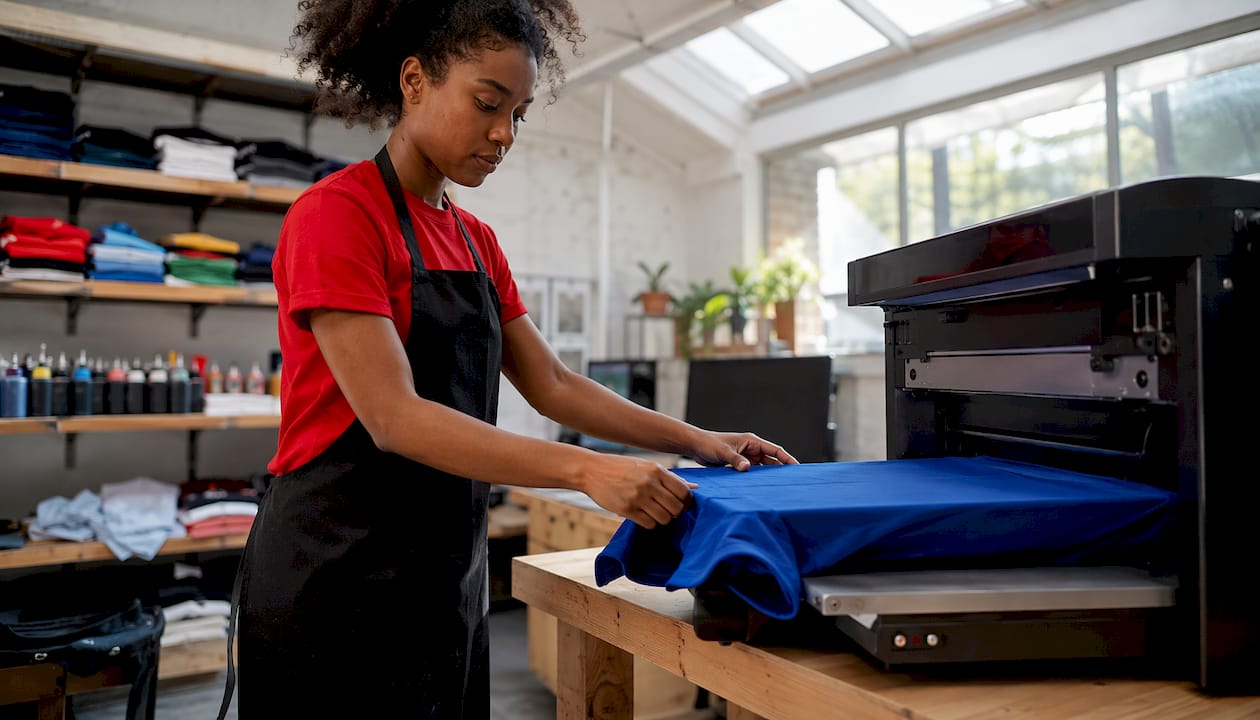
5. Choose DTF or DTG for small batches
For orders under roughly 24 pieces, or any job with full-color photographic artwork, DTF and DTG printing sidestep traditional setup costs almost entirely. No screens, no plates, no per-color charges.
6. Ask about screen reuse and rollovers
If you’ve ordered before, ask whether your screens or files are still on file and whether the shop will apply the previous setup to your new order. Many shops offer this within a set timeframe.
Pro Tip: Provide your artwork as a vector file (AI, EPS, or high-resolution PDF) with outlined fonts. It’s the single fastest way to avoid art-prep charges, and it signals to the shop that you’re a low-friction customer.
How Handmadeohiocrafts handles setup fees for small orders
Handmadeohiocrafts produces everything in-house at its Waverly, Ohio facility, which gives it direct control over how setup fees are applied and where they can be reduced or eliminated.
For small-batch orders, the shop’s primary recommendation is DTF transfers. Because DTF is a digital process, there are no screens to burn and no per-color charges. A full-color design costs the same to set up as a single-color one, which makes it the most cost-efficient option for orders without a large minimum.
Handmadeohiocrafts also provides DTF file requirements guidance so customers can submit print-ready artwork and avoid art-prep fees entirely. The shop accepts gang sheets, meaning multiple designs can be printed on a single transfer sheet, which further reduces the effective cost per design.
Questions worth asking when you contact the shop:
- Can my design be gang-sheeted with other artwork to reduce per-transfer cost?
- If I reorder the same DTF design, will you retain my file?
- What file format do you need to avoid any art-prep charge?
- Do you offer any setup rollover for repeat customers?
Handmadeohiocrafts ships nationwide and has no minimum order requirement, which means you’re not forced to over-order just to make the economics work. For a quote or to upload your artwork, visit the custom apparel page.
Key Takeaways
A printing setup fee is a fixed, one-time charge per run that covers the physical work and materials needed to prepare your artwork for production, and the method you choose determines how much of that cost you’ll actually pay.
| Point | Details |
|---|---|
| Setup fee definition | A one-time charge per run covering screens, plates, makeready, and art prep before production begins. |
| Method drives cost | Digital methods (DTF, DTG) carry little to no setup; screen printing and offset carry the highest charges. |
| Crossover point | Calculate total cost at your quantity to find where a high-setup method beats a low-setup digital alternative. |
| Best cost-control tactics | Simplify your design, reduce color count, supply print-ready files, and order enough units to spread the fixed cost. |
| Handmadeohiocrafts option | DTF transfers with no minimums and in-house file prep eliminate most traditional setup costs for small batches. |
The misunderstanding most buyers walk in with
The most common thing buyers get wrong about setup fees is treating them as a profit grab. They’re not. A setup fee is payment for physical work that happens before your job can run at all. When a shop burns a screen, makes a plate, or digitizes an embroidery file, those are real labor hours and real materials consumed on your behalf.
What does deserve scrutiny is vague or bundled setup charges with no itemization. A shop that quotes you a flat “setup fee” without explaining what’s inside it is making it impossible for you to compare quotes fairly. The fee might be entirely reasonable, but you can’t know that without a breakdown. Plates, makeready, proofing, and consumables are separate cost drivers. Asking for them listed separately is not being difficult; it’s being a smart buyer.
The other misunderstanding: assuming a reorder is always cheaper. It often is, but only if your specs haven’t changed and the shop still has your files. Change the ink color, switch garment styles, or come back after the shop’s file-retention window closes, and you’re paying setup again. Get the reorder policy in writing the first time.
Good file prep is the one thing buyers control completely. A clean, properly formatted file that arrives ready to print skips the art-prep step entirely. That’s not a minor detail. Shops price art cleanup into setup because it’s genuinely time-consuming. Hand them a file that needs no work, and you’ve removed a real cost from the equation.
Handmadeohiocrafts cuts setup costs for small-batch orders
For small businesses and individuals who need custom apparel without the overhead of traditional setup fees, Handmadeohiocrafts offers a direct alternative. The shop’s DTF transfer service runs on a fully digital workflow, which means no screens, no plates, and no per-color charges regardless of how complex your design is.
In-house production in Waverly, Ohio means the shop handles file prep, gang-sheeting, and transfer application under one roof, with nationwide shipping and no minimum order requirement. You’re not paying for a middleman’s markup or a large print run you don’t need. For full-color designs, event merch, or one-off custom pieces, DTF transfers from Handmadeohiocrafts are built to keep your effective cost per piece low from the first unit.
Ready to get a quote? Visit the custom apparel page, upload your artwork, and the team will walk you through which method keeps your setup costs lowest for your specific order.